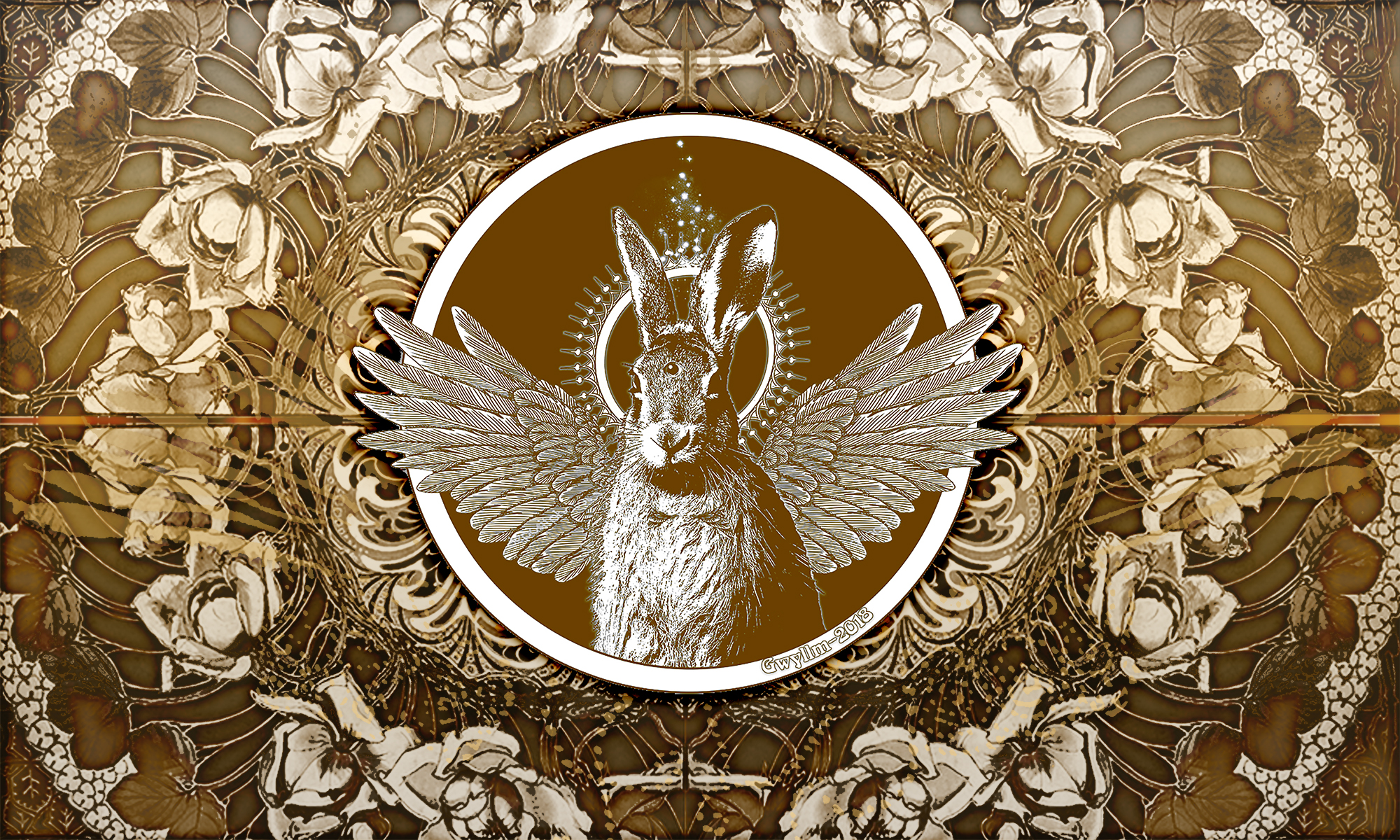
Beltane Fires: Eternal Revolutions…

Just because we’ve arms doesn’t mean we can’t fly.– Gwyllm

Friday Evening… if you are in Portland or nearby!
Come to the Portland Muralist Art Show! – Opening: May 2nd, 5-9PM!

Olympic Mills Commerce Center, 107 SE Washington Street, PDX – May 2-June 28
Opening Reception: First Friday, May 2, 5-9PM
Come by, and say hello. Hugs Guaranteed!

I hope you have had a good Beltaine, and I hope the weekend will be a beautiful one for you and yours.
Much Love to my Family and Circle of Friends where ever you may be!
Bright Blessings,
Gwyllm

______

On the Menu:

Albert Hofmann 1906-2008

The Links

Roberto Venosa’s Talking Portrait of Terence McKenna

The Fire-Festivals of Europe – The Beltane Fires

Poetry For Beltane: Robert Graves

Steve Roach – Cloud Motion

____________
Albert Hofmann 1906-2008
We would like to say a fond farewell to Albert Hofmann, the father of LSD, and one of the messengers of the modern age.
A man who blended science with mysticism, and practiced a deep and abiding love.
Without his work, we’d still be in the dark ages, and more than likely Turf would not be here today…
Albert died this week, 102 years of age. Of sound mind, and sound body up to his last day, he was in the midst of the alpine spring when he let go of his mortal coil.
Thank You Albert for your gifts, and I feel blessed to have been touched by the magick you brought, and how you helped shape the world as a better place.
A Good Voyage, and I hope Anita was there when you burst through the door of light.

__________
The Links:

‘Give Peace A Chance’ lyrics going on sale in London

New African Art, Resisting Assimilation

Shades of The Ranters: Are the Quakers Going Pagan?

Rush Limbaugh ‘Dreaming’ Of Riots In Denver

Unclear On Basic Concepts: Psychiatrist says S.C. teen accused in plot is competent

__________

Roberto Venosa’s Talking Portrait of Terence McKenna

=en_US&fs=1&”>

__________

The Fire-Festivals of Europe – The Beltane Fires

(From The Golden Bough)
In the Central Highlands of Scotland bonfires, known as the Beltane fires, were formerly kindled with great ceremony on the first of May, and the traces of human sacrifices at them were particularly clear and unequivocal. The custom of lighting the bonfires lasted in various places far into the eighteenth century, and the descriptions of the ceremony by writers of that period present such a curious and interesting picture of ancient heathendom surviving in our own country that I will reproduce them in the words of their authors. The fullest of the descriptions is the one bequeathed to us by John Ramsay, laird of Ochtertyre, near Crieff, the patron of Burns and the friend of Sir Walter Scott. He says: “But the most considerable of the Druidical festivals is that of Beltane, or May-day, which was lately observed in some parts of the Highlands with extraordinary ceremonies. … Like the other public worship of the Druids, the Beltane feast seems to have been performed on hills or eminences. They thought it degrading to him whose temple is the universe, to suppose that he would dwell in any house made with hands. Their sacrifices were therefore offered in the open air, frequently upon the tops of hills, where they were presented with the grandest views of nature, and were nearest the seat of warmth and order. And, according to tradition, such was the manner of celebrating this festival in the Highlands within the last hundred years. But since the decline of superstition, it has been celebrated by the people of each hamlet on some hill or rising ground around which their cattle were pasturing. Thither the young folks repaired in the morning, and cut a trench, on the summit of which a seat of turf was formed for the company. And in the middle a pile of wood or other fuel was placed, which of old they kindled with tein-eigin—i.e., forced-fire or need-fire. Although, for many years past, they have been contented with common fire, yet we shall now describe the process, because it will hereafter appear that recourse is still had to the tein-eigin upon extraordinary emergencies.
“The night before, all the fires in the country were carefully extinguished, and next morning the materials for exciting this sacred fire were prepared. The most primitive method seems to be that which was used in the islands of Skye, Mull, and Tiree. A well-seasoned plank of oak was procured, in the midst of which a hole was bored. A wimble of the same timber was then applied, the end of which they fitted to the hole. But in some parts of the mainland the machinery was different. They used a frame of green wood, of a square form, in the centre of which was an axle-tree. In some places three times three persons, in others three times nine, were required for turning round by turns the axle-tree or wimble. If any of them had been guilty of murder, adultery, theft, or other atrocious crime, it was imagined either that the fire would not kindle, or that it would be devoid of its usual virtue. So soon as any sparks were emitted by means of the violent friction, they applied a species of agaric which grows on old birch-trees, and is very combustible. This fire had the appearance of being immediately derived from heaven, and manifold were the virtues ascribed to it. They esteemed it a preservative against witch-craft, and a sovereign remedy against malignant diseases, both in the human species and in cattle; and by it the strongest poisons were supposed to have their nature changed.
“After kindling the bonfire with the tein-eigin the company prepared their victuals. And as soon as they had finished their meal, they amused themselves a while in singing and dancing round the fire. Towards the close of the entertainment, the person who officiated as master of the feast produced a large cake baked with eggs and scalloped round the edge, called am bonnach bea-tine—i.e., the Beltane cake. It was divided into a number of pieces, and distributed in great form to the company. There was one particular piece which whoever got was called cailleach beal-tine—i.e., the Beltane carline, a term of great reproach. Upon his being known, part of the company laid hold of him and made a show of putting him into the fire; but the majority interposing, he was rescued. And in some places they laid him flat on the ground, making as if they would quarter him. Afterwards, he was pelted with egg-shells, and retained the odious appellation during the whole year. And while the feast was fresh in people’s memory, they affected to speak of the cailleach beal-tine as dead.”
In the parish of Callander, a beautiful district of Western Perthshire, the Beltane custom was still in vogue towards the end of the eighteenth century. It has been described as follows by the parish minister of the time: “Upon the first day of May, which is called Beltan, or Baltein day, all the boys in a township or hamlet, meet in the moors. They cut a table in the green sod, of a round figure, by casting a trench in the ground, of such circumference as to hold the whole company. They kindle a fire, and dress a repast of eggs and milk in the consistence of a custard. They knead a cake of oatmeal, which is toasted at the embers against a stone. After the custard is eaten up, they divide the cake into so many portions, as similar as possible to one another in size and shape, as there are persons in the company. They daub one of these portions all over with charcoal, until it be perfectly black. They put all the bits of the cake into a bonnet. Every one, blindfold, draws out a portion. He who holds the bonnet, is entitled to the last bit. Whoever draws the black bit, is the devoted person who is to be sacrificed to Baal, whose favour they mean to implore, in rendering the year productive of the sustenance of man and beast. There is little doubt of these inhuman sacrifices having been once offered in this country, as well as in the east, although they now pass from the act of sacrificing, and only compel the devoted person to leap three times through the flames; with which the ceremonies of this festival are closed.”
Thomas Pennant, who travelled in Perthshire in the year 1769, tells us that “on the first of May, the herdsmen of every village hold their Bel-tien, a rural sacrifice. They cut a square trench on the ground, leaving the turf in the middle; on that they make a fire of wood, on which they dress a large caudle of eggs, butter, oatmeal and milk; and bring besides the ingredients of the caudle, plenty of beer and whisky; for each of the company must contribute something. The rites begin with spilling some of the caudle on the ground, by way of libation: on that every one takes a cake of oatmeal, upon which are raised nine square knobs, each dedicated to some particular being, the supposed preserver of their flocks and herds, or to some particular animal, the real destroyer of them: each person then turns his face to the fire, breaks off a knob, and flinging it over his shoulders, says, ‘This I give to thee, preserve thou my horses; this to thee, preserve thou my sheep; and so on.’ After that, they use the same ceremony to the noxious animals: ‘This I give to thee, O fox! spare thou my lambs; this to thee, O hooded crow! this to thee, O eagle!’ When the ceremony is over, they dine on the caudle; and after the feast is finished, what is left is hid by two persons deputed for that purpose; but on the next Sunday they reassemble, and finish the reliques of the first entertainment.”
Another writer of the eighteenth century has described the Beltane festival as it was held in the parish of Logierait in Perthshire. He says: “On the first of May, O.S., a festival called Beltan is annually held here. It is chiefly celebrated by the cow-herds, who assemble by scores in the fields, to dress a dinner for themselves, of boiled milk and eggs. These dishes they eat with a sort of cakes baked for the occasion, and having
small lumps in the form of nipples, raised all over the surface.” In this last account no mention is made of bonfires, but they were probably lighted, for a contemporary writer informs us that in the parish of Kirkmichael, which adjoins the parish of Logierait on the east, the custom of lighting a fire in the fields and baking a consecrated cake on the first of May was not quite obsolete in his time. We may conjecture that the cake with knobs was formerly used for the purpose of determining who should be the “Beltane carline” or victim doomed to the flames. A trace of this custom survived, perhaps, in the custom of baking oatmeal cakes of a special kind and rolling them down hill about noon on the first of May; for it was thought that the person whose cake broke as it rolled would die or be unfortunate within the year. These cakes, or bannocks as we call them in Scotland, were baked in the usual way, but they were washed over with a thin batter composed of whipped egg, milk or cream, and a little oatmeal. This custom appears to have prevailed at or near Kingussie in Inverness-shire.
In the north-east of Scotland the Beltane fires were still kindled in the latter half of the eighteenth century; the herdsmen of several farms used to gather dry wood, kindle it, and dance three times “southways” about the burning pile. But in this region, according to a later authority, the Beltane fires were lit not on the first but on the second of May, Old Style. They were called bone-fires. The people believed that on that evening and night the witches were abroad and busy casting spells on cattle and stealing cows’ milk. To counteract their machinations, pieces of rowan-tree and woodbine, but especially of rowan-tree, were placed over the doors of the cow-houses, and fires were kindled by every farmer and cottar. Old thatch, straw, furze, or broom was piled in a heap and set on fire a little after sunset. While some of the bystanders kept tossing the blazing mass, others hoisted portions of it on pitchforks or poles and ran hither and thither, holding them as high as they could. Meantime the young people danced round the fire or ran through the smoke shouting, “Fire! blaze and burn the witches; fire! fire! burn the witches.” In some districts a large round cake of oat or barley meal was rolled through the ashes. When all the fuel was consumed, the people scattered the ashes far and wide, and till the night grew quite dark they continued to run through them, crying, “Fire! burn the witches.”
In the Hebrides “the Beltane bannock is smaller than that made at St. Michael’s, but is made in the same way; it is no longer made in Uist, but Father Allan remembers seeing his grandmother make one about twenty-five years ago. There was also a cheese made, generally on the first of May, which was kept to the next Beltane as a sort of charm against the bewitching of milk-produce. The Beltane customs seem to have been the same as elsewhere. Every fire was put out and a large one lit on the top of the hill, and the cattle driven round it sunwards (dessil), to keep off murrain all the year. Each man would take home fire wherewith to kindle his own.”
In Wales also the custom of lighting Beltane fires at the beginning of May used to be observed, but the day on which they were kindled varied from the eve of May Day to the third of May. The flame was sometimes elicited by the friction of two pieces of oak, as appears from the following description. “The fire was done in this way. Nine men would turn their pockets inside out, and see that every piece of money and all metals were off their persons. Then the men went into the nearest woods, and collected sticks of nine different kinds of trees. These were carried to the spot where the fire had to be built. There a circle was cut in the sod, and the sticks were set crosswise. All around the circle the people stood and watched the proceedings. One of the men would then take two bits of oak, and rub them together until a flame was kindled. This was applied to the sticks, and soon a large fire was made. Sometimes two fires were set up side by side. These fires, whether one or two, were called coelcerth or bonfire. Round cakes of oatmeal and brown meal were split in four, and placed in a small flour-bag, and everybody present had to pick out a portion. The last bit in the bag fell to the lot of the bag-holder. Each person who chanced to pick up a piece of brown-meal cake was compelled to leap three times over the flames, or to run thrice between the two fires, by which means the people thought they were sure of a plentiful harvest. Shouts and screams of those who had to face the ordeal could be heard ever so far, and those who chanced to pick the oatmeal portions sang and danced and clapped their hands in approval, as the holders of the brown bits leaped three times over the flames, or ran three times between the two fires.”

The belief of the people that by leaping thrice over the bonfires or running thrice between them they ensured a plentiful harvest is worthy of note. The mode in which this result was supposed to be brought about is indicated by another writer on Welsh folk-lore, according to whom it used to be held that “the bonfires lighted in May or Midsummer protected the lands from sorcery, so that good crops would follow. The ashes were also considered valuable as charms.” Hence it appears that the heat of the fires was thought to fertilise the fields, not directly by quickening the seeds in the ground, but indirectly by counteracting the baleful influence of witchcraft or perhaps by burning up the persons of the witches.
The Beltane fires seem to have been kindled also in Ireland, for Cormac, “or somebody in his name, says that belltaine, May-day, was so called from the ‘lucky fire,’ or the ‘two fires,’ which the druids of Erin used to make on that day with great incantations; and cattle, he adds, used to be brought to those fires, or to be driven between them, as a safeguard against the diseases of the year.” The custom of driving cattle through or between fires on May Day or the eve of May Day persisted in Ireland down to a time within living memory.
The first of May is a great popular festival in the more midland and southern parts of Sweden. On the eve of the festival huge bonfires, which should be lighted by striking two flints together, blaze on all the hills and knolls. Every large hamlet has its own fire, round which the young people dance in a ring. The old folk notice whether the flames incline to the north or to the south. In the former case, the spring will be cold and backward; in the latter, it will be mild and genial. In Bohemia, on the eve of May Day, young people kindle fires on hills and eminences, at crossways, and in pastures, and dance round them. They leap over the glowing embers or even through the flames. The ceremony is called “burning the witches.” In some places an effigy representing a witch used to be burnt in the bonfire. We have to remember that the eve of May Day is the notorious Walpurgis Night, when the witches are everywhere speeding unseen through the air on their hellish errands. On this witching night children in Voigtland also light bonfires on the heights and leap over them. Moreover, they wave burning brooms or toss them into the air. So far as the light of the bonfire reaches, so far will a blessing rest on the fields. The kindling of the fires on Walpurgis Night is called “driving away the witches.” The custom of kindling fires on the eve of May Day (Walpurgis Night) for the purpose of burning the witches is, or used to be, widespread in the Tyrol, Moravia, Saxony and Silesia.

__________

Poetry For Beltane: Robert Graves


Rhea
On her shut lids the lightning flickers,

Thunder explodes above her bed,

An inch from her lax arm the rain hisses;

Discrete she lies,
Not dead but entranced, dreamlessly

With slow breathing, her lips curved

In a half-smile archaic, her breast bare,

Hair astream.
The house rocks, a flood suddenly rising

Bears away bridges: oak and ash

Are shivered to the roots – royal green timber.

She nothing cares.
(Divine Augustus, trembling at the storm,

Wrapped sealskin on his thumb; divine Gaius

Made haste to hide himself in a deep cellar,

Distraught by fear.)
Rain, thunder, lightning: pretty children.

“Let them play,” her mother-mind repeats;

“They do no harm, unless from high spirits

Or by mishap.”

In The Wilderness
He, of his gentleness,

Thirsting and hungering

Walked in the Wilderness;

Soft words of grace he spoke

Unto lost desert-folk

That listned wondering.

He heard the bittern call

From ruined palace-wall,

Answered him brotherly;

He held communion

With the she-pelican

Of lonely piety.

Basilisk, cockatrice,

Flocked to his homilies,

With mail of dread device,

With monstrous barbed stings,

With eager dragon-eyes;

Great bats on leathern wings

And old, blind, broken things

Mean in their miseries.

Then ever with him went,

Of all his wanderings

Comrade, with ragged coat,

Gaunt ribs — poor innocent –

Bleeding foot, burning throat,

The guileless young scapegoat;

For forty nights and days

Followed in Jesus’ ways,

Sure guard behind him kept,

Tears like a lover wept.

The White Goddess
All saints revile her, and all sober men

Ruled by the God Apollo’s golden mean –

In scorn of which we sailed to find her

In distant regions likeliest to hold her

Whom we desired above all things to know,

Sister of the mirage and echo.
It was a virtue not to stay,

To go our headstrong and heroic way

Seeking her out at the volcano’s head,

Among pack ice, or where the track had faded

Beyond the cavern of the seven sleepers:

Whose broad high brow was white as any leper’s,

Whose eyes were blue, with rowan-berry lips,

With hair curled honey-coloured to white hips.
The sap of Spring in the young wood a-stir

Will celebrate with green the Mother,

And every song-bird shout awhile for her;

But we are gifted, even in November

Rawest of seasons, with so huge a sense

Of her nakedly worn magnificence

We forget cruelty and past betrayal,

Heedless of where the next bright bolt may fall.
Robert Graves

__________

Steve Roach – Cloud Motion
=en_US&fs=1&”>

____________

Winstanley….

‘liberty cannot be provided for in a general sense if property is preserved.’

Be There Or Be Square!
Portland Muralist Art Show! – Opening: May 2nd, 5-9PM!
Olympic Mills Building Gallery –The Portland Mural Show
Olympic Mills Commerce Center, 107 SE Washington Street, PDX – May 2-June 28
Opening Reception: First Friday, May 2, 5-9PM

Closing Party/Paint Off: June 28, NOON – 6
www.olympicmill.com www.myspace.com/olympicmillsart
Featuring the work of local Portland muralists over the past 20 years. (Please see partial list of participating artists. There will be more.)
This show is a snapshot of extant mural work around Portland and a showcase for new work by local muralists.
Since 1998, there has been no easily accessible path to public murals in Portland. On the heels of the 2007 legal decision by Judge Michael Marcus deeming mural art legally sound, there is word that the city will soon open most walls to a simple mural permitting process. In exuberant display, local muralists show work & anticipate the opportunity of painting legally on public walls.
In this show there will be photos sketches, original work and documentation of some of your favorite Portland murals places…Outside In, The Musicians Union, Community Cycling Center, S.C.R.A.P.
There will be display of older murals…. “Struggle and Hope” honoring Ben Linder circa 1988, and also the “We Speak ” mural about the Columbus Quincentary circa 1992.
There will be live action painters hard at work at the opening party on May 2.
There will be a talk about public mural art at the opening by local artist Baba Wague and activist Martin Gonzalez . The opening is community mural style potluck. Bring something.
Artists Represented:
Charlotte Lewis

Ping Khaw

Mike Hensley

Robin Corbo

Emily Lutz

Charlie Alan Kraft

Sara Stout

Sheri Love

Jennifer Mercede

Larry Kangas

Joe Cotter

Kolieha Bush

Mark Meltzer

Asa Kennedy

Jay Meer

Eileen Belanger

Nicholas M. Olmsted

Chris Haberman

Kenny Spurlock

Jason Coatney

Gwyllm Llwydd

Rin Carroll Jackson

John Early

Laura Bender

Mark Larsen

Angelina Marino

Joel Heidel

Jesse Valesquez

Joanne Oleksiak

Bruce Orr

Carol Forté

Tom Cramer

Josh Wallace

Kate Sullivan

Eric Klanton

Jan York

William Park

Ryan Shanks

Tim Karpniski (and Together Gallery)

Donna Guardino

(and others)
From the site of the historic B&O Building, the heavily remodeled Olympic Mills Commerce Center is a multi-small business complex with natural sky lights, 24K sq.ft. of main floor art gallery and 7 floors of office space.
10% of art show proceeds go to local charities.
Art shows run in 2-month exhibitions. Support Local Arts, Support Portland City Art.

____________________________________________
So Morgan brought over ‘Winstanley’ this past week (on DVD)… I have had this entry sitting since 1/22/08, and held off until I saw the film. Amazing really, shot on 16mm, for a budget in 1974 of 17,000 British Pounds. It is well worth seeing, as it tells a pivotal tale the reverberates until today, and may I say, past us…
In the next couple of weeks we will be investigating various forms of communities and ideas about community that are in stark contrast to the present state of affairs here in the post – industrial west…
Remember, we are only as limited as our imaginations, and we can, and will create a new society, whether by intentionality, or by accident, something new is on the way, so we may as well help birth something better…
So… check ‘Winstanley’ out. We are all part of a long tradition, and there are so many tales to be known…
Painting away for the show this weekend, but I had to get this out!

On The Menu:

Tom Middleton – Sea Of Glass

Winstanley, The Diggers

William Blake: Poetry…
Bright Blessings,
Gwyllm

_______

Tom Middleton – Sea Of Glass
=en_US&fs=1&”>

________

Winstanley, The Diggers

Excerpt from Communalism: From Its Origins to the Twentieth Century

By Kenneth Rexroth


Surprisingly the seventeenth century with its almost continuous wars of religion was not a good time for the radical Reformation. Cujis regio, ejus religio — religion had become a matter of large-scale politics. Wars fought between nations and alliances of nations divided Europe into blocks of Catholics, Lutherans, and Calvinists. Small groups of the elect were crushed out by the sheer weight of the contending monsters. Then, too, the Thirty Years War, which was fought to destroy the Holy Roman Empire as the dominant power in Europe, also crushed or profoundly distorted the culture of the various parts of the empire. Germany emerged fragmented and wasted and did not recover for generations. The radical Reformation had been a natural outgrowth of the culture of the late medieval middle of Europe and the Thirty Years War destroyed its roots. In the Netherlands, Switzerland, and amongst the Hutterites in their remote refuges, a process of fossilization had set in.
The English Civil War and commonwealth were essentially a product of class struggle, and the proliferation of sects in the latter days of the Civil War took place almost entirely in a lower middle class and upper working class context. In spite of their name, the Levellers were far from being unbridled democrats. They proposed to extend participation in power only to men of substance — small, middle-class substance — like themselves. The Fifth Monarchy men were such extreme chiliasts as to have no real social program.
The Ranters were only incidentally millenarians. Basically they were a revival of the Brotherhood of the Free Spirit, who believed that once divinized and absorbed into the Godhead the soul was incapable of evil. Like the Adamites who were expelled from Tabor they lived exalted in an amoral ecstasy. If they practiced community of goods, nudism, speaking with tongues, and sexual orgies it was all part of a frantic, hurried, and hunted life lived in a state of unrelieved excitement. Some Ranters were simply extreme Spiritualists, descendants of Meister Eckhart and the Rhineland mystics; and with the Restoration of Charles II they were absorbed into the Quakers. They really lay completely outside the development of English Puritanism.
The agitation of the Levellers lasted only three years. They were primarily a political party who wished to see the promises of the Rump Parliament — the recruiting propaganda for the second stage of the Civil War — fulfilled. Their leader, John Lilburne, had been an associate of Cromwell’s at the beginning and the Levellers were perfectly right when they accused him of selling out. Although the final form of their Agreement of the Free People of England, their political manifesto, proposes a broader democracy than would come to England until the end of the nineteenth century, they did not believe in universal franchise, but excluded servants, paupers, farm laborers, Roman Catholics, Episcopalians, Royalists, “heretics,” and, of course, women. Essentially they were left-wing Calvinist republicans. By the end of 1649 they had been completely suppressed.
In 1653 the Nominated or “Barebones” Parliament, chosen from the leaders of the Independent Churches, sat briefly; but its attempts to inaugurate the rule of the saints were so radical and disorganized that Cromwell dissolved them and became dictator — “Protector.” This led to a revolt of the more extreme millenarians, to whom Cromwell became the “Little Horn” of the Beast of the Apocalypse. They proposed to establish a ruthless despotism of the elect in preparation for the final kingdom of the millennium. The Fifth Monarchy movement, lacking both ideology and social program, sprang up through an inflamed rhetoric which consisted exclusively of the reiteration and rearrangement of the apocalyptic language of the Books of Daniel and Revelation. It was a massive hysterical outburst of rage by men who knew they had been betrayed. Unlike the Levellers, they took to armed revolt. In April 1657 a handful of men rushed about London fighting as they went and were quickly suppressed. In January 1661 another, even more frantic and desperate attempt occurred, and those who were not killed in the streets were executed, and the sect came to an end.
Movements like the old Family of Love, the Seekers, and the Quakers grew in the interstices of the English Reformation, at first so clandestinely that from Henry VIII to the emergence of the Quakers we know surprisingly little about them. Various groups were accused of practicing community of goods; but although the movement was widespread, at least in the imagination of its persecutors, each individual group seems to have been a tiny conventicle, with members meeting in one another’s’ homes and sharing their resources. Theologically the older Anabaptism died out in England and was replaced by Spiritualism. The modern Baptist sect which arose in those days was an independent development which owed practically nothing to continental Anabaptism but was rather a special form of Calvinism. In the writing and preaching of George Fox and the earliest Quakers there were no special social or economic concerns, and it was only after the Restoration with the consolidation of modern Quakerism in the days of William Penn that the Quakers became anti-political.
A little group of unemployed laborers and landless peasants gathered at St. George’s Hill near Walton-on-Thames in Surrey on April 1, 1649, and began to dig up the common land and prepare for sowing vegetables. Their leaders were William Everard and Gerrard Winstanley. At first their activities aroused curiosity and a certain amount of sympathy but as time went on the local lords of the manor, the gentry, aroused the populace and the mob shut the Diggers up in the church at Walton until they were released by a justice of the peace. Again they were captured by a mob and locked up in the nearby town of Kingston and again released. On April 16 a complaint was laid before the Council of State, who sent two groups of cavalry to investigate.
The captain, Gladman, reported that the incident was trivial and sent Everard and Winstanley to London to explain themselves to Thomas Fairfax. They explained that since the Norman Conquest England had been under a tyranny which was now abolished, but that now God would relieve the poor and restore their freedom to enjoy the fruits of the earth. The two men explained that they did not intend to interfere with private property, but only to plant and harvest on the many wastelands of England, and to live together holding all things in common. They were certain that their example would be followed by the poor and dispossessed all over England, and in the course of time all men would give up their possessions and join them in community.
A month later Lord Fairfax stopped by on his way to London, to see for himself what was happening, and decided it was a matter for the local authorities. In June another mob, including some soldiers, assaulted the Diggers and trampled their crops. Winstanley complained to Fairfax and the soldiers were apparently ordered to leave the Diggers alone. In June the Diggers announced that they intended to cut and sell the wood on the common, and at this point the landlords sued for damages and trespass. The court awarded damages of ten pounds and costs, and took the cows Winstanley was pasturing on the common, but released them because they were not his property.
Perhaps because of the judgment, and because their crops had all been destroyed, the Diggers moved in the autumn to the common of Cobham Manor, built four houses, and started a crop of winter grain. By this time there were over fifty Diggers. When they refused to disperse, Fairfax finally sent troops who, with the mob, destroyed two of the houses and again trampled the fields. The Diggers persisted and by spring they had eleven acres of growing grain and six or seven houses and similar movements had sprung up i
n Northamptonshire and Kent. The landlord, a clergyman, John Platt, turned his cattle into the young grain and led a mob in destroying houses and driving out the Diggers and their women and children.
On April 1, 1650, Winstanley and fourteen others (Everard, who seems to have been demented, vanishes early in the story) were indicted for disorderly conduct, unlawful assembly, and trespass. There is no record of the disposal of the indictment, but this was the end of the little communist society at Cobham.
This is all there was to the Digger movement, a trivial episode which was a ninety-day wonder in the news sheets when it first started, and which was almost without influence at the time, and easily could have been lost to history — except for the writings of Gerrard Winstanley. All during the course of the experiment he issued a series of pamphlets which, as his ideas rapidly evolved, came to constitute the first systematic exposition of libertarian communism in English.
All the tendencies of the radical Reformation seem to flow together in Winstanley, to be blended and secularized, and become an ideology rather than a theology. Spiritualism, radical Unitarianism, apostolic communism, evangelical rationalism — one could easily believe that he was well read in the entire literature of the radical Reformation. Yet we know nothing of his intellectual background, reading, or influences. He never quotes a secular authority, only the Bible, in all his writings, and we know nothing about his education, and little enough about his life. He says again and again that his ideas owe nothing to any other man or to any book, only to the Inner Light and to its “openings” in visionary experiences. Perhaps that is true.
Gerrard Winstanley was born in the village of Wigan in 1609, in a family of small gentry and merchants that had long been prominent in England. His father Edward was registered as a mercer and the son was raised in the cloth trade. Somewhere he must have received a fairly good education for a provincial middle-class boy because, although he never uses, as did everybody else in his day, a classical quotation, this very avoidance would indicate not only that he was well educated but quite sophisticated, and the prose style in his later pamphlets is that of a highly literate man. At the age of twenty he was in London, apprenticed to Sarah Gater, widow of William Gater of the Merchant Taylor’s company, and at twenty-eight he became a freeman and went into business for himself. Three years later he married Susan King. In the depression which began in 1643 he went bankrupt, and he was still being sued by one of his creditors in 1660. After his bankruptcy, he left London to stay with friends in the neighborhood of Cobham and Walton-on-Thames in Surrey where, to judge from his troubles over the cows, he made a living pasturing other people’s cattle on the common.
At some time before his first publication Winstanley joined the Baptists and may have been a preacher for them, but before 1648 he had come to believe that baptism was only an unimportant form and had ceased to attend Baptist conventicles. Rather he met with those little groups of Seekers who gathered in one another’s homes and waited for the Inner Light, and spoke only ex tempore. At this time he went through a period of temptation, guilt, fear of death and damnation, of devils and ghosts, and a sense of loss and abandonment, a time of spiritual crisis universal in the lives of the great mystics. Finally, he came to an abiding consciousness of God within himself, the assurance of universal salvation, and the peace which comes with direct experience of mystical illumination. His first two publications are really devoted to assimilating this experience. They move from a highly spiritualized chiliasm, developing a well-reasoned doctrine of universal salvation, to a highly spiritualized philosophy of history rather than a theology.
Even in these early pamphlets Winstanley has original insights. His chiliasm does not take the form of the salvation of a handful of the elect but of the divinization of man. In his teachings on sin and salvation the original sin of Adam was not lust but covetousness — selfishness and the desire for power — in which Winstanley shows himself an incomparably more astute moralist than the Puritans. Ultimately, the God who operates in history, in all things, and consciously in the soul of man, is called “Reason.” It would be a mistake to decide from this, as some modern writers have done, that Winstanley was a precursor of eighteenth-century rationalism. His reason is the ineffable God of Plotinus and Meister Eckhart apprehended in the mystical experience, though not separated from man as the Omnipotent Creator, but as the ultimately realizable in all things. So for him the narrative of the Old Testament and the life and passion of Christ cease to be historical documents about something that happened in the past and become symbolic archetypes of the cosmic drama of the struggle of good and evil that takes place in the soul of man.
When the Digger tracts began with the adventure at St. George’s Hill, Winstanley’s basic appeal was not to the practice of the apostles or to an eschatological ethic in preparation for apocalypse. His communism begins with an “opening,” an actual vision, and the appeal is always to his transcendent and imminent Reason — to a spiritualized natural law, not unlike the Tao of Chuang Tsu.
Likewise I heard these words: “Worke together. Eat bread together. Declare all this abroad.” Likewise I heard these words: “Whosoever it is that labours in the earth or any person or persons that lifts up themselves as Lords and Rulers over others and that doth not look upon themselves equal to others in the creation, the Hand of the Lord shall be upon the labourer. I the Lord have spoke it and I will do it. Declare all this abroad.” [The New Law of Righteousness, 1648]
This vision came not as a command from on high, but as a voice opening out of the experience of nature itself, for, says Winstanley, the doctrine of an anthropomorphic deity, set over against and independent of nature,
is the doctrine of a sickly and weak spirit who hath lost his understanding in the knowledge of the Creation and of the temper of his own Heart and Nature and so runs into fancies. [The Law of Freedom in a Platform or True Magistracy Restored, 1652]
To know the secrets of nature, is to know the works of God; and to know the works of God within the creation, is to know God himself, for God dwells in every visible work or body. And indeed if you would know spiritual things, it is to know how the Spirit or Power of Wisdom and Life, causing motion or growth, dwells within and governs both the several bodies of the stars and planets in the heavens above and the several bodies of the earth below as grass, plants, fishes, beasts, birds and mankinde. [Ibid.]
Belief in an outward heaven or hell is a “strange conceit,” a fraud by which men are delivered over into the power of their oppressors,
. . . a fancy which your false teachers put into your heads to please you with, while they pick your purses and betray your Christ into the hands of flesh, and hold Jacob under to be a servant still to Lord Esau. [The New Law of Righteousness]
True religion and undefiled is this, to make restitution of the Earth which hath been taken and held from the common people by the power of Conquests formerly and so set the oppressed free. [A New Yeers Gift for the Parliament and the Armie, 1650]
The earth with all her fruits of Corn, Cattle and such like was made to be a common Store-House of Livelihood, to all mankinde, friend and foe, without exception. [A Declaration from the Poor Oppressed People of England, 1649]
And this particular propriety [property] of mine and thine that brought in all misery upon people. For first it hath occasioned people to steal from one another. Secondly it hath made laws to hang those that did steal. It tempts people to do an evil action and then
kills them for doing it. [The New Law of Righteousness]
Now, this same power in man that causes divisions and war is called by some men the state of nature which every man brings into the world with him. . . . But this law of darknesse is not the State of Nature. [Fire in the Bush, 1650]
. . . the power of Life (called the Law of Nature within the creatures) which does move both man and beast in their actions; or that causes grass, trees, corn and all plants to grow in their several seasons; and whatsoever any body does, he does it as he is moved by this inward Law. And this Law of Nature moves twofold viz. unrationally or rationally. [The Law of Freedom in a Platform or True Magistracy Restored]
In the beginning of time the great creator Reason made the earth to be a common treasury . . . not one word was spoken in the beginning that one branch of mankind should rule over another. [The True Levellers Standard Advanced, 1649]
. . . the power of inclosing Land and owning Propriety was brought into the Creation by your ancestors by the Sword which first did murther their fellow-creatures men and after plunder or steal away their land. [A Declaration from the Poor Oppressed People of England]
They have by their subtle imagination and covetous wit got the plain-hearted poor or younger brethren to work for them for small wages and by their work have got a great increase. [The True Levellers Standard Advanced]
By large pay, much Free-Quarter and other Booties which they call their own they get much Monies and with this they buy Land. [Ibid.]
No man can be rich, but he must be rich, either by his own labors, or the labors of other men helping him: If a man have no help from his neighbor, he shall never gather an Estate of hundreds and thousands a year: If other men help him to work, then are those Riches his Neighbors, as well as his own, for they be the fruit of other mens labors as well as his own. But all rich men live at ease, feeding and clothing themselves by the labor of other men and not by their own; which is their shame and not their Nobility: for it is a more blessed thing to give than to receive. But rich men receive all they have from the laborers hand, and what they give, they give way other mens labors not their own. [The Law of Freedom in a Platform or True Magistracy Restored]
. . . if once landlords, then they rise to be Justices, Rulers and State Governours as experience shewes. [The True Levellers Standard Advanced]
. . . the power of the murdering and theeving sword formerly as well as now of late years hath set up a government and maintains that government; for what are prisons and putting others to death, but the power of the Sword to enforce people to that Government which was got by Conquest and sword and cannot stand of itself but by the same murdering power. [A Declaration from the Poor Oppressed People of England]
. . . the Kingly power sets up a Law and Rule of Government to walk by; and here Justice is pretended but the full strength of the Law is to uphold the conquering Sword and to preserve his son Propriety. . . . For though they say the Law doth punish yet indeed the Law is but the strength, life and marrow of the Kingly power upholding the Conquest still, hedging some into the Earth, hedging out others; giving the Earth to some and denying the Earth to others, which is contrary to the Law of Righteousnesse who made the Earth at first as free for one as for another. . . . Truly most Laws are but to enslave the Poor to the Rich and so they uphold the Conquest and are Laws of the great Red Dragons. [A New Yeers Gift for the Parliament and the Armie]
Winstanley borrowed from the Levellers the idea that in Anglo-Saxon England there had been an equitable sharing of land; and that at the Norman Conquest great estates had been created, and the old population dispossessed or driven into serfdom; and that this unequal division of the basic wealth of the land had been perpetuated ever since solely by the power of the sword; and that law and established religion were just devices to uphold the sword; and finally, that the overthrow of the king, the heir of the Norman power, had resulted in no important change. The old laws still stood. A new Church, first of the Presbyterians and then of the Independents, was established, and the grandees of the new commonwealth were enriching themselves like William the Conqueror’s knights, while the common people sank deeper into poverty. Winstanley’s interpretation of English history has been considered naïve, but there is much to be said for it. Anglo-Saxon England was in fact a frontier country, and all through the Dark Ages, following the catastrophic depopulation that began in the fifth century, there was much free land all over Europe and even more in the British Isles.
He says of caterpillar lawyers that “they love money as dearly as a poor man’s dog do his breakfast in a cold morning and they are such neat workmen, that they can turn a cause which way those that have the biggest purse have them.”
O you Parliament-men of England, cast those whorish laws out of doors, that are so common, that pretend love to everyone, and is faithful to none. For truly, he that goes to law, as the proverb is, shall die a beggar. So that old whores, and old laws, picks men’s pockets and undoes them . . . burn all your law books in Cheapside, and set up your government upon your own foundations. Do not put new wine into old bottles; but as your government must be new so let the laws be new, or else you will run farther into the mud, where you stick already, as though you were fast in an Irish bog. [A New Yeers Gift for the Parliament and the Armie]
As for the church:
And do we not yet see that if the Clergie can get Tithes or Money they will turn as the Ruling power turns, any way . . . to Papacy, to Protestantisme; for a King, against a King; for monarchy, for Some Government; they cry who bids most wages, they will be on the strongest side for an earthly maintenance. . . . There is a confederacie between the Clergy and the great red Dragon. The sheep of Christ shall never fare well so long as the wolf or red Dragon payes the Shepherd their wages. [Ibid.]
For Winstanley private property, but especially the property in land as the source of all wealth, “is the cause of all wars, bloodshed, theft and enslaving laws that hold the people under miserie.” Private property divides man from man and nation from nation and leads to a state of continuous war on which the state power flourishes.
Winstanley was the first to discover that axiom made famous by Randolph Bourne — “War is the health of the State.” He also had the curious and original idea that only in time of war does the power structure encourage scientific invention. “Otherwise the Kingly Bondage is the cause of the spreading of ignorance in the earth for fear of want and care to pay rent to taskmasters hath hindered many rare inventions and the secrets of creation have been locked up under the traditional parrot-like speaking from the Universities and Colleges for Scholars.” War, says Winstanley, makes the rich richer and the poor poorer and tightens the bonds of power.
Winstanley was a devout pacifist all during the Digger experiment; and one reason for the violent abuse of the Diggers, the destruction of their shanties, and the injury and killing of their livestock, was due to the fact that they put up no resistance. They believed that their example, if only they were permitted to cultivate the commons and wastelands, would be so infectious that soon it would be followed by all the poor of England; and that when they had established a community of love, interpenetrating all of English society, their success would lead even the rich and powerful to join them, and eventually all Europe would turn communist persuaded only by example.
Socialists, modern Communists, anarchists, all claim Winstanley as an ancestor. In fact his ideas bear most resemblance to those of the left-wing followers of
Henry George’s Single Tax. For him the source of all wealth was in land and its development in the application of labor to the resources of the earth. If these resources were held in common, and all men were permitted to develop them freely, and men labored in common, then the resulting wealth, even of crafts and manufactures, would naturally become communalized. Modern contemporary Marxists have called this economics naïve, but it was held at the beginning of the twentieth century by an economist who was anything but naïve, Henry George, who attracted many thousand intelligent followers, and it is after all the fundamental assumption of Marx himself. But it was not his economics that was most important to Winstanley. What he sought was a spiritual condition in mankind which would be in harmony with the working of Reason in nature — the return of man, who had fallen into covetousness, to the universal harmony. Winstanley’s communism was not an economic doctrine, but mutual aid followed from his organic philosophy as a logical consequence.
After the suppression of the little commune of Diggers Winstanley was quiet for a while. Then in 1652 he published, with a preface submitting it to Cromwell, his plan for a new commonwealth — The Law of Freedom in a Platform or True Magistracy Restored. The Digger pamphlets present no plan for administrative or governmental policy. Winstanley seems to have assumed that the example of small anarchist-communist groups working in occupied land in brotherhood would sweep all before it and convert England and eventually the world. The problems of self-defense and internal disruption are met by total pacifism before which power must simply dissolve. The violent suppression of the Diggers by both mob and authority forced Winstanley to consider the question of power anew.
The Law of Freedom, after a general introduction, is concerned largely with administrative plans, and the introduction is an appeal to Cromwell to use his power to introduce the new commonwealth. If you do not, says Winstanley, abolish the old power of conquest of the king and nobles, but only turn it over to other men, “you will either lose yourself or lay the foundation of greater slavery to posterity than you ever knew,” a chilling forecast of the dark Satanic mills of early British capitalism.
In the preamble he outlines the principal popular grievances, lack of religious toleration, survival of the old priesthood, the burden of tithes — a tenth of all income for an established Church, arbitrary administration of justice, the old laws are still enforced, the old feudal dues and obligations are still used to oppress the people, while the upper classes ignore their feudal obligations and enclose or abuse the common lands. These are the same grievances we are familiar with from the Hussite Wars and the Peasants’ Revolt in Germany.
Winstanley points out that true freedom does not consist in free trade, freedom of religion, or community of women, but freedom in the use of the earth, the natural treasure of society, and that the first duty of the new commonwealth should be to open the land to all people and to take over the former holdings of the king, the Church, and the nobility. To do this properly, and to use the land fruitfully for the good of all, society needs true government, administrative officers who will be devoted to freedom and the commonweal.
The original root of magistracy was in the family, and the first magistrate is the father, as the finally responsible member of a group in which all are mutually responsible. Officers of the society should be chosen by complete manhood suffrage for all over twenty, and at first only representatives of the old order need to be barred, although notorious evil livers are not fit to be chosen. They should be above forty years of age and hold office for one year only so that responsibility can be rotated throughout the community. First are the overseers, the peace officers who form a local council in each community. They preserve public order and suppress crime and quarrelling and disputes over household property and other chattels which remain in private possession. Others plan the distribution of labor and assign the young to apprenticeships. Others oversee the production of the craftsmen and farmers. Winstanley envisages manufactures as being carried on largely in people’s homes with a few public workshops. Apprenticeships normally take place within the family; only boys who do not wish to follow their fathers’ trade are assigned to the public workshops. Others organize the distribution of goods and food which go to warehouses and shops, both wholesale and retail, from which both craftsmen and consumers are free to choose what they wish.
In each community there is a “soldier,” what we would call a policeman, whose duty is to enforce the decisions of the peacemaker, a taskmaster to whom is given the rule of those convicted of crimes against the community and who assigns them to common labor. There is also an executioner who administers corporal or capital punishment to the hopelessly recalcitrant. Winstanley’s system of penalties may seem excessively severe to us, especially in a utopian society, but in their day, when people were hung for petty theft, they were relatively mild. In the county or shire the peacemakers of the towns, the overseers, and the soldiers, presided over by a judge, form the county senate and court of first appeal. Over all is parliament, which Winstanley seems to have thought of as primarily a court of final appeal, and he is very strongly opposed to its indulging in promiscuous legislation. Laws should be as few and simple as possible. What Winstanley had in mind was a polity like the Israelites in the Book of Judges — in fact the neolithic village with spontaneous justice administered by the elders sitting under a tree. Curiously he says nothing about juries or any other form of democratization of justice. Society defends itself by a militia and Winstanley has a most perceptive section on the evils of standing armies, militarism, and war.
Education in the new commonwealth is free, general, compulsory, and continues through life. Everyone is to be taught a trade or a craft at which he is to work part-time, whatever else he comes to do. No caste of intellectuals or academicians set apart from the people by booklearning is to be permitted to arise, although after the age of forty men “shall be freed from all labor and work unless they will themselves.” The death penalty is decreed for those who attempt to make a living by law or religion. In each community there shall be a “postmaster” who corresponds with all the others in the country directly and through a central postmaster in the chief city. They exchange news, especially news of progress in science, invention, and technology. Sunday is a day of rest. The people gather to listen to a reading of the laws, the news of the postmaster, and what we would call papers on learning and science. Religious services are not mentioned. The people are apparently at liberty to attend them if they wish. Marriage and divorce are civil, exclusively at the will of parties, and take place by simple declaration before the community with the overseers as witnesses.
Winstanley’s utopia has been criticized as being excessively simple and himself as naïve; and even more naïve, his idea that Cromwell would put in force such a policy, or probably even bother to read his pamphlet. Ideological discussion with his sectarian opponents was, whenever he had time, an indoor sport with Cromwell, but he never allowed it to influence him. We must not forget he lived in a time of revolutionary hope. In those days, as in the beginning of the Reformation on the continent, it seemed quite possible to intelligent men that an entirely new social order might be established. Everyone was something of a millenarian and believed that a new historical epoch was beginning. They could not foresee the rise of industrialism, capitalism, the secular State. To us, their future is the past and seems to have
been inevitable. There was nothing inevitable about it to them. Perhaps if Cromwell, or even Luther, had foreseen the horrors of the early industrial age in the nineteenth century, or the genocide and wars of extermination of the twentieth, they might have chosen the commonwealth of Winstanley or the community life of the Hutterites. In each great crisis of Western European civilization, the Reformation, the French Revolution, the revolutions of 1848, the First World War, the Bolshevik Revolution, the Spanish Civil War, the Second World War, it has seemed quite possible to change the world. It is only after the fact that the historical process appears to be the only way in which events could have worked out.
Was Winstanley’s utopia a workable polity? Within limits, yes. Whether he knew it or not, it is remarkably similar to that of the Taborites, the Moravian Brethren, the Hutterites, and the most successful and enduring communalist settlements in nineteenth-century America. His plans went into the common stock of ideas of later English communists and directly or indirectly influenced John Bellers, Robert Owen, Josiah Warren, William Morris, Belford Bax, Édouard Bernstein, David Petegorsky. Other socialists, Communists, and anarchists wrote extensively about him in the first half of the twentieth century and after the Second World War he became extremely popular. Revolutionary communalist groups in England, America, Germany, and France would even call themselves Diggers.
Although the Quakers are by far the best known and largest, and a still surviving community descended from the Spiritualist Anabaptists, and hence ultimately from the underground apostolic community of the Middle Ages, they did not practice community of goods. Rather each Seventh-Day Meeting, as they called their conventicles, had a common fund for the relief of members in need. As a majority of Quakers became prosperous — due to their strict honesty in trade and crafts and, prior to 1760 when they refused to pay tithes and so gave up farming, their advanced agricultural methods — these common funds became quite large and many poor people joined the Society of Friends to obtain welfare funds vastly superior to contemporary poor relief. At first this caused problems but within a generation members who had joined for these reasons had been absorbed into the general economy of Quaker mutual aid and poor Quakers were less than a third of the proportion of poor in the general population, while well-to-do members were proportionately three times as many. Quaker welfare funds came to be used more and more for the general relief of the poor in systematic ways which would foster self-help. Quakers were the principal, almost the sole, financiers, besides himself, of Robert Owen’s model factory town of New Lanark, and they have continued to invest in communal and cooperative movements of which they approve to this day.
In his youth at Manchester College Owen’s closest friends were the Quaker John Dalton and another young Friend named Winstanley, quite possibly a descendant of the great Digger.
Far more than Robert Owen, the most systematic theorist of a cooperative labor colony was the Quaker John Bellers, who greatly impressed Marx. Owen always denied that he was influenced by Bellers and claimed that he had never heard of him until Francis Place showed him a unique copy of his forgotten pamphlet in 1817. Owen immediately had a thousand copies printed and distributed them to those he thought would be interested, and so Bellers survived.
Bellers was born in 1654, a birthright Quaker. He became a friend of William Penn and other leading men of the time. In 1695 during the long economic depression in the last years of the century, he published Proposals for Raising a College of Industry of All Useful Trades and Husbandry. He called it a college rather than a work house or community because the first was identified with the servile institutions of state poor relief and the second implied that all things should be held in common. For a capital investment of fifteen thousand pounds — worth considerably more than ten times as much today — Bellers envisaged a self-sustaining colony of three hundred adults with shops, commissary, crafts, farm land, barns, dairies, pottery. The community was to be self-sufficient even in fuel and iron. All members, from common laborers to the overseers and managers, were to be paid in kind. The dwelling house would have four wings — one for married couples, one for single men and young boys, one for single women and girls, and one an infirmary. Meals were to be in common. Bellers, like Winstanley before him, placed great emphasis upon education in the humanities, in the arts, and in crafts and trade combined. Bellers thought that the creative life of the community and the advanced educational methods would attract many who would wish to come as visitors or even permanent boarders; and even more would wish to enroll their children in school, and for these privileges they would be expected to pay well. He worked out in considerable detail the projected bookkeeping of his community and demonstrated that the original investors would gain a considerable profit, while at the same time the standard of living of the members would be far higher than that of the contemporary working class. The first edition of the pamphlet was dedicated to the Society of Friends, the second to Parliament, but no one came forward to invest in such a colony. During his remaining years Bellers issued a series of pamphlets, some of them devoted to a careful economic analysis of a semi-socialist economy, others proposing a league of nations, an ecumenical council of all Christian religions, a national health service, a reform of Parliament and the electoral process, a total reform of prisons, and a reform of the Poor Laws.
Although Robert Owen had worked out his own system before he read Bellers’s pamphlet and although Fourier, Saint-Simon, and Cabet had certainly never heard of him, he anticipated most of their more practicable ideas and in far more practicable form. Although all his writings soon became excessively rare, he should be considered the founder of modern, socially responsible Quakerism of the Service Committee variety. Furthermore the various measures he proposed in his reformist practice have almost all been incorporated in the modern welfare state. Although Marx called him “a veritable phenomenon in the history of political economy,” amazingly there has never been an edition of his collected works nor, with all the immense flood of scholarly research and Ph.D. theses, has anyone written a book about him. He is not even mentioned in Beer’s History of British Socialism. Most information about him is to be found in the final chapter of Édouard Bernstein’s Cromwell and Communism.

_______

William Blake: Poetry…

A Poison Tree
I was angry with my friend:

I told my wrath, my wrath did end.

I was angry with my foe;

I told it not, my wrath did grow.
And I water’d it in fears,

Night & morning with my tears;

And I sunned it with my smiles

And with soft deceitful wiles.
And it grew both day and night,

Till it bore an apple bright;

And my foe beheld it shine,

And he knew that it was mine,
And into my garden stole

When the night had veil’d the pole:

In the morning glad I see

My foe outstretch’d beneath the tree

The Blossom
Merry, merry sparrow!

Under leaves so green

A happy blossom

Sees you, swift as arrow,

Seek your cradle narrow,

Near my bosom.

Pretty, pretty robin!

Under leaves so green

A happy blossom

Hears you sobbing, sobbing,

Pretty, pretty robin,

Near my bosom.

The Echoing Green
The sun does arise,

And make happy the skies;

The merry bells ring

To welcome the Spring;

The skylark and thrush,

The birds of the bush,

Sing louder around

To the bells’ cheerful sound;

While our sports shall be seen

On the echoing green.
Old John, with white hair,

Does laugh away care,

Sitting under the oak,

Among the old folk.

They laugh at our play,

And soon they all say,

‘Such, such were the joys

When we all — girls and boys –

In our youth-time were seen

On the echoing green.’
Till the little ones, weary,

No more can be merry:

The sun does descend,

And our sports have an end.

Round the laps of their mothers

Many sisters and brothers,

Like birds in their nest,

Are ready for rest,

And sport no more seen

On the darkening green.

The Divine Image
The Mercy, Pity, Peace, and Love

All pray in their distress;

And to these virtues of delight

Return their thankfulness.
For Mercy, Pity, Peace, and Love

Is God, our Father dear,

And Mercy, Pity, Peace, and Love

Is man, His child and care.
For Mercy has a human heart,

Pity a human face,

And Love, the human form divine,

And Peace, the human dress.
Then every man, of every clime,

That prays in his distress,

Prays to the human form divine,

Love, Mercy, Pity, Peace.
For all must love the human form,

In heathen, Turk, or Jew;

Where Mercy, Love, and Pity dwell

There God is dwelling too.

Mock on, Mock on, Voltaire, Rousseau
Mock on, mock on, Voltaire, Rousseau:

Mock on, mock on: ‘tis all in vain!

You throw the sand against the wind,

And the wind blows it back again.
And every sand becomes a Gem,

Reflected in the beam divine;

Blown back they blind the mocking Eye,

But still in Israel’s paths they shine.
The Atoms of Democritus

And the Newton’s Particles of Light

Are sands upon the Red Sea shore,

Where Israel’s tents do shine so bright.

___________

Yab Yum


One of my favourite pictures… just a quick one, with a couple elements of note:
On The Menu:

Antony singing If It Be Your Will

The New Alchemy

John Cale – Hallelujah
Poetry is to be found with the Antony & John Cale Entries… From Leonard Cohen… (Thanks to Leanna and Richard for the nice evening of watching the Leonard Cohen Tribute film!)
The New Alchemy is from early writings on LSD by Alan Watts….
Have a good one!
Gwyllm

_______

An Amazing Voice!
Antony singing If It Be Your Will

=en_US&fs=1&”>
“If It Be Your Will”
If it be your will

That I speak no more

And my voice be still

As it was before

I will speak no more

I shall abide until

I am spoken for

If it be your will

If it be your will

That a voice be true

From this broken hill

I will sing to you

From this broken hill

All your praises they shall ring

If it be your will

To let me sing

From this broken hill

All your praises they shall ring

If it be your will

To let me sing
If it be your will

If there is a choice

Let the rivers fill

Let the hills rejoice

Let your mercy spill

On all these burning hearts in hell

If it be your will

To make us well
And draw us near

And bind us tight

All your children here

In their rags of light

In our rags of light

All dressed to kill

And end this night

If it be your will
If it be your will.

___

The New Alchemy

Alan Watts

an essay from This is It and Other Essays on Zen and Spiritual Experience,

by Alan Watts, Vintage Books, 1973, ©Alan Watts 1958, 1960.

This essay was written in 1960.
Besides the philosopher’s stone that would turn base metal into gold, one of the great quests of alchemy in both Europe and Asia was the elixir of immortality. In gullible enthusiasm for this quest, more than one Chinese emperor died of the fabulous concoctions of powdered jade, tea, ginseng, and precious metals prepared by Taoist priests. But just as the work of transforming lead into gold was in many cases a chemical symbolism for a spiritual transformation of man himself, so the immortality to be conferred by the elixir was not always the literally everlasting life but rather the transportation of consciousness into a state beyond time. Modern physicists have solved the problem of changing lead into gold, though the process is somewhat more expensive than digging gold from the earth. But in the last few years modem chemists have prepared one or two substances for which it may be claimed that in some cases they induce states of mind remarkably similar to cosmic consciousness.

To many people such claims are deeply disturbing. For one thing, mystical experience seems altogether too easy when it simply comes out of a bottle, and is thus available to people who have done nothing to deserve it, who have neither fasted nor prayed nor practiced yoga. For another, the claim seems to imply that-spiritual insight is after all only a matter of body chemistry involving a total reduction of the spiritual to the material. These are serious considerations, even though one may be convinced that in the long run the difficulty is found to rest upon semantic confusion as to the definitions of “spiritual” and “material.”

However, it should be pointed out that there is nothing new or disreputable in the idea that spiritual insight Is an undeserved gift of divine grace, often conveyed through such material or sacramental means as the water of baptism and the bread and wine of the mass. The priest who by virtue of his office transforms bread and wine into the body and blood of Christ, ex opere operato, by the simple repetition of the formula of the Last Supper, is in a situation not radically different from that of the scientist who, by repeating the right formula of an experiment, may effect a transformation in the brain. The comparative worth of the two operations must be judged by their effects. There were always those upon whom the sacraments of baptism and communion did not seem to “take,” whose lives remained effectively unregenerate. Likewise, none of these consciousness-changing chemicals are literally mystical experience in a bottle. Many who receive them experience only ecstasies without insight, or just an unpleasant confusion of sensation and imagination. States akin to mystical experience arise only in certain individuals and then often depend upon considerable concentration and effort to use the change of consciousness in certain ways. It is important here, too, to stress the point that ecstasy is only Incidental to the authentic mystical experience, the essence of which might best be described as insight, as the word is now used in psychiatry.

A chemical of this kind might perhaps be said to be an aid to perception in the same way as the telescope, microscope, or spectroscope, save in this case that the instrument is not an external object but an internal state of the nervous system. All such instruments are relatively useless without proper training and preparation not only in their handling, but also in the particular field of investigation,

These considerations alone are already almost enough to show that the use of such chemicals does not reduce spiritual insight to a mere matter of body chemistry. But it should be added that even when we can describe certain events in terms of chemistry this does not mean that such events are merely chemical. A chemical description of spiritual experience has somewhat the same use and the same limits as the chemical description of a great painting. It is simple enough to make a chemical analysis of the paint, and for artists and connoisseurs alike there is some point in doing so. It might also be possible to work out a chemical description of all the processes that go on in the artist while he is painting. But it would be incredibly complicated, and in the meantime the same processes could be described and communicated far more effectively in some other language than the chemical. We should probably say that a process is chemical only when chemical language is the most effective means of describing it. Analogously, some of the chemicals known as psychedelics provide opportunities for mystical insight in much the same way that well-prepared paints and brushes provide opportunities for fine painting, or a beautifully constructed piano for great music. They make it easier, but they do not accomplish the work all by themselves.

The two chemicals which are of most use in creating a change of consciousness conducive to spiritual experience are mescaline and lysergic acid diethylamide (known, for short, as LSD). The former is a synthetic formulation of the active ingredients of the peyote cactus, and the latter a purely synthetic chemical of the indole group which produces its effects even in such minute amounts as twenty-five micrograms. The specific effects of these chemicals are hard to identify with any clarity, and so far as is known at present they seem to operate upon the nervous system by reducing some of the inhibitory mechanisms which ordinarily have a screening effect upon our consciousness. Certain psychiatrists who seem overly anxious to hang on to the socially approved sensation of reality—more or less the world as perceived on a bleak Monday morning—classify these chemicals as hallucinogens producing toxic effects of a schizoid or psychotic character. I am afraid this is psychiatric gobbledygook: a sort of authoritative rumble of disapproval. Neither substance is an addictive drug, like heroin or opium, and it has never been demonstrated that they have harmful effects upon people who were not otherwise seriously disturbed. It is begging the question to call the changes of consciousness which they educe hallucinations, for some of the unusual things felt and seen may be no more unreal than the unfamiliar forms perceived through a microscope. We do not know. It is also begging the question to call their effects toxic, which might mean poisonous, unless this word can also be used for the effects of vitamins or proteins. Such language is evaluative, not descriptive in any scientific sense.

Somewhat more than two years ago (1958) I was asked by a psychiatric research group to take 100 micrograms of lysergic acid, to see whether it would reproduce anything resembling a mystical experience. It did not do so, and so far as I know the reason was that I had not then learned how to direct my inquiries when under its influence. It seemed instead that my senses had been given a kaleidoscopic character (and this is no more than a metaphor) which made the whole world entrancingly complicated, as if I were involved in a multidimensional arabesque. Colors became so vivid that flowers, leaves, and fabrics seemed to be illumined from inside. The random patterns of blades of grass in a lawn appeared to be exquisitely organized without, however, any actual distortion of vision. Black ink or sumi paintings by Chinese and Japanese artists appeared almost to be three dimensional photographs, and what are ordinarily dismissed as irrelevant details of speech, behavior, appearance, and form seemed in some indefinable way to be highly significant. Listening to music with closed eyes, I beheld the most fascinating patterns of dancing jewelry, mosaic, tracery, and abstract images. At one point everything appeared to be uproariously funny, especially the gestures and actions of people going about their everyday business. Ordinary remarks seemed to reverberate with double and quadruple meanings, and the role-playing behavior of those around me not only became unusually evident but also implied concealed attitudes contrary or complementary to its overt intention. In short, the screening or selective apparatus of our normal interpretative evaluation of experience had been partially suspended, with the result that I was presumably projecting the sensation of meaning or significance upon just about everything. The whole experience was vastly entertaining and interesting, but as yet nothing like any mystical experience that I had had before.

It was not until a year later that I tried LSD again, this time at the request of another research team. Since then I have repeated the experiment five times, with dosages varying from 75 to 100 micrograms. My impression has been that such experiments are profound and rewarding to the extent that I do my utmost to observe perceptual and evaluative changes and to describe them as clearly and completely as possible, usually with the help of a tape recorder. To give a play-by-play description of each experiment might be clinically interesting, but what I am concerned with here is a philosophical discussion of some of the high points and recurrent themes of my experiences. Psychiatrists have not yet made up their minds as to whether LSD is useful in therapy, but at present I am strongly inclined to feel that its major use may turn out to be only secondarily as a therapeutic and primarily as an instrumental aid to the creative artist, thinker, or scientist. I should observe, in passing, that the human and natural environment in which these experiments are conducted is of great importance, and that its use in hospital wards with groups of doctors firing off clinical questions at the subject is most undesirable. The supervising physician should take a human attitude, and drop all defensive dramatizations of scientific objectivity and medical authority, conducting the experiment in surroundings of some natural or artistic beauty.

I have said that my general impression of the first experiment was that the “mechanism” by which we screen our sense-data and select only some of them as significant had been partially suspended. Consequently, I felt that the particular feeling which we associate with “the meaningful” was projected indiscriminately upon everything, and then rationalized in ways that might strike an independent observer as ridiculous—unless, perhaps, the subject were unusually clever at rationalizing. However, the philosopher cannot pass up the point that our selection of some sense-data as significant and others as insignificant is always with relation to particular purposes—survival, the quest for certain pleasures, finding one’s way to some destination, or whatever it may be. But in every experiment with LSD one of the first effects I have noticed is a profound relaxation combined with an abandonment of purposes and goals, reminding me of the Taoist saying that “when purpose has been used to achieve purposelessness, the thing has been grasped.” I have felt, in other words, endowed with all the time in the world, free to look about me as if I were living in eternity without a single problem to be solved. It is just for this reason that the busy and purposeful actions of other people seem at this time to be so comic, for it becomes obvious that by setting themselves goals which are always in the future, in the “tomorrow which never comes,” they are missing entirely the point of being alive.

When, therefore, our selection of sense-impressions is not organized with respect to any particular purpose, all the surrounding details of the world must appear to be equally meaningful or equally meaningless. Logically, these are two ways of saying the same thing, but the overwhelming feeling of my own LSD experiences is that all aspects of the world become meaningful rather than meaningless. This is not to say that they acquire meaning in the sense of signs, by virtue of pointing to something else, but that all things appear to be their own point. Their simple existence, or better, their present formation, seems to be perfect, to be an end or fulfillment without any need for justification. Flowers do not bloom in order to produce seeds, nor are seeds germinated in order to bring forth flowers. Each stage of the process—seed, sprout, bud, flower, and fruit— may be regarded as the goal. A chicken is one eggs way of producing others. In our normal experience something of the same kind takes place in music and the dance, where the point of the action is each moment of its unfolding and not just the temporal end of the performance.

Such a translation of everyday experience into something of the same nature as music has been the beginning and the prevailing undertone of all my experiments. But LSD does not simply suspend the selective process by cutting it out. It would be more exact to say that it shows the relativity of our ordinary evaluation of sense-data by suggesting others. It permits the mind to organize its sensory impressions in new patterns. In my second experiment I noticed, for example, that all repeated forms—leaves on a stem, books on shelves, mullions in windows—gave me the sensation of seeing double or even multiple, as if the second, third, and fourth leaves on the stem were reflections of the first, seen, as it were, in several thicknesses of window glass. When I mentioned this, the attending physician held up his finger to see if it would give me a double image. For a moment it seemed to do so, but all at once I saw that the second image had its basis in a wisp of cigar smoke passing close to his finger and upon which my consciousness had projected the highlights and outline of a second finger. As I then concentrated upon this sensation of doubling or repeating images, it seemed suddenly as if the whole field of sight were a transparent liquid rippled in concentric circles as in dropping a stone into a pool. The normal images of things around me were not distorted by this pattern. They remained just as usual, but my attention directed itself to highlights, lines, and shadows upon them that fitted the pattern, letting those that did not fall into relative insignificance. As soon, however, as I noticed this projection and became aware of details that did not fit the pattern, it seemed as if whole handfuls of pebbles had been thrown into-the optical space, rippling it with concentric circles that overlapped in all directions, so that every visible point became an intersection of circles. The optical field seemed, in fact, to have a structured grain like a photograph screened for reproduction, save that the organization of the grains was not rectilinear but circular. In this way every detail fitted the pattern and the field of vision became pointillist, like a painting by Seurat.

This sensation raised a number of questions. Was my mind imperiously projecting its own geometrical designs upon the world, thus “hallucinating” a structure in things which is not actually there? Or is what we call the “real” structure of things simply a learned projection or hallucination which we hold in common? Or was I somehow becoming aware of the actual grain of the rods and cones in my retina, for even a hallucination must have some actual basis in the nervous system? On another occasion I was looking closely at a handful of sand, and in becoming aware that I could not get it into clear focus I became conscious of every detail and articulation of the way in which my eyes were fuzzing the image—and this was certainly perception of a grain or distortion in the eyes themselves.

The general impression of these optical sensations is that the eyes, without losing the normal area of vision, have become microscopes, and that the texture of the visual field is infinitely rich and complex. I do not know whether this is actual awareness of the multiplicity of nerve-endings in the retina, or, for that matter, in the fingers, for the same grainy feeling arose in the sense of touch. But the effect of feeling that this is or may be so is, as it were, to turn the senses back upon themselves, and so to realize that seeing the external world is also seeing the eyes. In other words, I became vividly aware of the fact that what I call shapes, colors, and textures in the outside world are also states of my nervous system, that is, of me. In knowing them I also know my self. But the strange part of this apparent sensation of my own senses was that I did not appear to be inspecting them from outside or from a distance, as if they were objects. I can say only that the awareness of grain or structure in the senses seemed to be awareness of awareness, of myself from inside myself. Because of this, it followed that the distance or separation between myself and my senses, on the one hand, and the external world, on the other, seemed to disappear I was no longer a detached observer, a little man inside my own head, having sensations. I was the sensations, so much so that there was nothing left of me, the observing ego, except the series of sensations which happened—not to me, but just happened—moment by moment, one after another.

To become the sensations, as distinct from having them, engenders the most astonishing sense of freedom and release. For it implies that experience is not something in which one is trapped or by which one is pushed around, or against which one must fight. The conventional duality of subject and object, knower and known, feeler and feeling, is changed into a polarity: the knower and the known become the poles, terms, or phases of a single event which happens, not to me or from me, but of itself. The experiencer and the experience become a single, ever-changing self-forming process, complete and fulfilled at every moment of its unfolding, and of infinite complexity and subtlety. It is like, not watching, but being, a coiling arabesque of smoke patterns in the air, or of ink dropped in water, or of a dancing snake which seems to move from every part of its body at once. This may be a “drug-induced hallucination,” but it corresponds exactly to what Dewey and Bentley have called the transactional relationship of the organism to its environment. This is to say that all our actions and experiences arise mutually from the organism and from the environment at the same time. The eyes can see light because of the sun, but the sun is light because of the eyes. Ordinarily, under the hypnosis of social conditioning, we feel quite distinct from our physical surroundings, facing them rather than belonging in them. Yet in this way we ignore and screen out the physical fact of our total interdependence with the natural world. We are as embodied in it as our own cells and molecules are embodied in us. Our neglect and repression of this interrelationship gives special urgency to all the new sciences of ecology, studying the interplay of organisms with their environments, and warning us against ignorant interference with the balances of nature.

The sensation that events are happening of themselves, and that nothing is making them happen and that they are not happening to anything, has always been a major feature of my experiences with LSD. It is possible that the chemical is simply giving me a vivid realization of my own philosophy, though there have been times when the experience has suggested modifications of my previousthinking. (1) But just as the sensation of subject-object polarity is confirmed by the transactional psychology of Dewey and Bentley, so the sensation of events happening “of themselves” is just how one would expect to perceive a world consisting entirely of process. Now the language of science is increasingly a language of process—a description of events, relations, operations, and forms rather than of things and substances. The world so described is a world of actions rather than agents, verbs rather than nouns, going against the common-sense idea that an action is the behavior of some thing, some solid entity of “stuff.” But the commonsense idea that action is always the function of an agent is so deeply rooted, so bound up with our sense of order and security, that seeing the world to be otherwise can be seriously disturbing. Without agents, actions do not seem to come from anywhere, to have any dependable origin, and at first sight this spontaneity can be alarming. In one experiment it seemed that whenever I tried to put my (metaphorical) foot upon some solid ground, the ground collapsed into empty space. I could find no substantial basis from which to act: my will was a whim, and my past, as a causal conditioning force, had simply vanished. There was only the present conformation of events, happening. For a while I felt lost in a void, frightened, baseless, insecure through and through Yet soon I became accustomed to the feeling, strange as it was. There was simply a pattern of action, of process, and this was at one and the same time the universe and myself with nothing outside it either to trust or mistrust. And there seemed to be no meaning in the idea of its trusting or mistrusting itself, just as there is no possibility of a finger’s touching its own tip.

Upon reflection, there seems to be nothing unreasonable in seeing the world in this way. The agent behind every action is itself action. If a mat can be called matting, a cat can be called catting. We do not actually need to ask who or what “cats,” just as we do not need to ask what is the basic stuff or substance out of which the world is formed—for there is no way of describing this substance except in terms of form, of structure, order, and operation. The world is not formed as if it were inert clay responding to the touch of a potter’s hand; the world is form, or better, formation, for upon examination every substance turns out to be closely knit pattern. The fixed notion that every pattern or form must be made of some basic material which is in itself formless is based on a superficial analogy between natural formation and manufacture, as if the stars and rocks had been made out of something as a carpenter makes tables out of wood. Thus what we call the agent behind the action is simply the prior or relatively more constant state of the same action: when a man runs we have a “manning-running” over and above a simple “manning.” Furthermore, it is only a somewhat clumsy convenience to say that present events are moved or caused by past events, for we are actually talking about earlier and later stages of the same event. We can establish regularities of rhythm and pattern in the course of an event, and so predict its future configurations, but its past states do not “push” its present and future states as if they were a row of dominoes stood on end so that knocking over the first collapses all the others in series. The fallen dominoes lie where they fall, but past events vanish into the present, which is just another way of saying that the world is a self-moving pattern which, when its successive states are remembered, can be shown to have a certain order. Its motion, its energy, issues from itself now, not from the past, which simply falls behind it in memory like the wake from a ship.

When we ask the “why” of this moving pattern, we usually try to answer the question in terms of its original, past impulse or of its future goal. I had realized for a long time that if there is in any sense a reason for the world’s existence it must be sought in the present, as the reason for the wake must be sought in the engine of the moving ship. I have already mentioned that LSD makes me peculiarly aware of the musical or dance-like character of the world, bringing my attention to rest upon its present flowing and seeing this as its ultimate point. Yet I have also been able to see that this point has depths, that the present wells up from within itself with an energy which is something much richer than simple exuberance.

One of these experiments was conducted late at night. Some five or six hours from its start the doctor had to go home, and I was left alone in the garden. For me, this stage of the experiment is always the most rewarding in terms of insight, after some of its more unusual and bizarre sensory effects have worn off. The garden was a lawn surrounded by shrubs and high trees—Pine and eucalyptus—and floodlit from the house which enclosed it on one side. As I stood on the lawn I noticed that the rough patches where the grass was thin or mottled with weeds no longer seemed to be blemishes. Scattered at random as they were, they appeared to constitute an ordered design, giving the whole area the texture of velvet damask, the rough patches being the parts where the pile of the velvet is cut. In sheer delight I began to dance on this enchanted carpet, and through the thin soles of my moccasins I could feel the ground becoming alive under my feet, connecting me with the earth and the trees and the sky in such a way that I seemed to become one body with my whole surroundings.

Looking up, I saw that the stars were colored with the same reds, greens, and blues that one sees in iridescent glass, and passing across them was the single light of a jet plane taking forever to streak over the sky. At the same time, the trees, shrubs, and flowers seemed to be living jewelry, inwardly luminous like intricate structures of jade, alabaster, or coral, and yet breathing and flowing with the same life that was in me. Every plant became a kind of musical utterance, a play of variations on a theme repeated from the main branches, through the stalks and twigs, to the leaves, the veins in the leaves, and to the fine capillary network between the veins. Each new bursting of growth from a center repeated or amplified the basic design with increasing complexity and delight, finally exulting in a flower.

From my description it will seem that the garden acquired an atmosphere that was distinctly exotic, like the gardens of precious stones in the Arabian Nights, or like scenes in a Persian miniature. This struck me at the time, and I began to wonder just why it is that the glowingly articulated landscapes of those miniatures seem exotic, as do also many Chinese and Japanese paintings. Were the artists recording what they, too, had seen under the influence of drugs? I knew enough of the lives and techniques of Far Eastern painters to doubt this. I asked, too, whether what I was seeing was “drugged.” In other words, was the effect of the LSD in my nervous system the addition to my senses of some chemical screen which distorted all that I saw to preternatural loveliness? Or was its effect rather to remove certain habitual and normal inhibitions of the mind and senses, enabling us to see things as they would appear to us if we were not so chronically repressed? Little is known of the exact neurological effects of LSD, but what is known suggests the latter possibility. If this be so, it is possible that the art forms of other cultures appear exotic—that is, unfamiliarly enchanting—because we are seeing the world through the eyes of artists whose repressions are not the same as ours. The blocks in their view of the world may not coincide with ours, so that in their representations of life we see areas that we normally ignore. I am inclined to some such solution because there have been times when I have seen the world in this magical aspect without benefit of LSD, and they were times when I was profoundly relaxed within, my senses unguardedly open to their surroundings.

Feeling, then, not that I was drugged but that I was in an unusual degree open to reality, I tried to discern the meaning, the inner character of the dancing pattern which constituted both myself and the garden, and the whole dome of the night with its colored stars. All at once it became obvious that the whole thing was love-play, where love means everything that the word can mean, a spectrum ranging from the red of erotic delight, through the green of human endearment, to the violet of divine charity, from Freud’s libido to Dante’s “love that moves the sun and other stars.” All were so many colors issuing from a single white light, and, what was more, this single source was not just love as we ordinarily understand it: it was also intelligence, not only Eros and Agape but also Logos. I could see that the intricate organization both of the plants and of my own nervous system, like symphonies of branching complexity, were not just manifestations of intelligence—as if things like intelligence and love were in themselves substances or formless forces. It was rather that the pattern itself is intelligence and is love, and this somehow in spite of all its outwardly stupid and cruel distortions.

There is probably no way of finding objective verification for insights such as this. The world is love to him who treats it as such, even when it torments and destroys him, and in states of consciousness where there is no basic separation between the ego and the world suffering cannot be felt as malice inflicted upon oneself by another. By the same logic it might seem that with out the separation of self and other there can be no love. This might be true if individuality and universality were formal opposites, mutually exclusive of one another, if, that is, the inseparability of self and other meant that all individual differentiations were simply unreal. But in the unitary, or nondualistic, view of the world I have been describing this is not so. Individual differences express the unity, as branches, leaves, and flowers from the same plant, and the love between the members is the realization of their basic interdependence.

I have not yet been able to use LSD in circumstances of great physical or moral pain, and therefore my explorations of the problem of evil under its influence may appear to be shallow. Only once in these experiments have I felt acute fear, but I know of several cases in which LSD has touched off psychic states of the most alarming and unpleasant kind. More than once I have invited such states under LSD by looking at images ordinarily suggestive of “the creeps”—the mandibles of spiders, and the barbs and spines of dangerous fish and insects. Yet they evoked only a sense of beauty and exuberance, for our normal projection of malice into these creatures was entirely withdrawn, so that their organs of destruction became no more evil than the teeth of a beautiful woman. On another occasion I looked for a long time at a colored reproduction of Van Eyck’s Last Judgment, which is surely one of the most horrendous products of human imagination. The scene of hell is dominated by the figure of Death, a skeleton beneath whose batlike wings lies a writhing mass of screaming bodies gnawed by snakes which penetrate them like maggots in fruit. One of the curious effects of LSD is to impart an illusion of movement in still images, so that here the picture came to life and the whole entanglement of limbs and serpents began to squirm before my eyes. (2)

Ordinarily such a sight should have been hideous, but now I watched it with intense and puzzled interest until the thought came to me, “Demon est deus inversus—the Devil is God inverted—so let’s turn the picture upside down.” I did so, and thereupon burst into laughter for it became apparent at once that the scene was an empty drama, a sort of spiritual scarecrow, designed to guard some mystery from profanation by the ignorant. The agonized expressions of the damned seemed quite evidently “put on,” and as for the death’s-head, the great skull in the center of the painting, it became just what a skull is—an empty shell—and why the horror when there is nothing in it?

I was, of course, seeing ecclesiastical hells for what they are. On the one hand, they are the pretension that social authority is ultimately inescapable since there are post-mortem police who will catch every criminal. On the other hand, they are “no trespassing” signs to discourage the insincere and the immature from attaining insights which they might abuse. A baby is put in a play pen to keep it from getting at the matches or falling downstairs, and though the intention of the pen is to keep the baby closed in, parents are naturally proud when the child grows strong enough to climb out. Likewise, a man can perform actions which are truly moral only when he is no longer motivated by the fear of hell, that is, when he grows into union with the Good that is beyond good and evil, which, in other words, does not act from the love of rewards or the fear of punishments. This is precisely the nature of the world when it is considered as self-moving action, giving out a past instead of being motivated by a past.

Beyond this, the perception of the empty threat of the death’s-head was certainly a recognition of the fact that the fear of death, as distinct from the fear of dying, is one of the most baseless mirages that trouble us. Because it is completely impossible to imagine one’s own personal absence, we fill the void in our minds with images of being buried alive in perpetual darkness. If death is the simple termination of a stream of consciousness, it is certainly nothing to fear. At the same time, I realize that there is some apparent evidence for survival of death in a few extraordinarily unexplainable mediumistic communications and remembrances of past lives. These I attribute, vaguely enough, to subtler networks of communication and interrelationship in the pattern of life than we ordinarily perceive. For if forms repeat themselves, if the structure of branching trees is reverberated in the design of watercourses in the desert, it would not be so strange if a pattern so intricate as the human nervous system were to repeat configurations that arise in consciousness as veritable memories of the most distant times. My own feeling, and of course it is nothing more than an opinion, is that we transcend death, not as individual memory-systems, but only in so far as our true identity is the total process of the world as distinct from the apparently separate organism.

As I have said, this sense of being the whole process is frequently experienced with LSD, and, for me, it has often arisen out of a strong feeling of the mutuality of opposites. Line and plane, concept and percept, solid and space, figure and ground, subject and object appear to be so completely correlative as to be convertible into each other. At one moment it seems that there are, for example, no lines in nature: there are only the boundaries of planes, boundaries which are, after all, the planes themselves. But at the next moment, looking carefully into the texture of these planes, one discovers them to be nothing but a dense network of patterned lines. Looking at the form of a tree against the sky, I have felt at one moment that its outline “belongs” to the tree, exploding into space. But the next moment I feel that the same form is the “inline” of the sky, of space imploding the tree. Every pull is felt as a push, and every push as a pull, as in rotating the rim of a wheel with one’s hand. Is one pushing or pulling?

The sense that forms are also properties of the space in which they expand is not in the least fantastic when one considers the nature of magnetic fields, or, say, the dynamics of swirling ink dropped into water. The concepts of verbal thought are so clumsy that we tend to think only of one aspect of a relationship at a time. We alternate between seeing a given form as a property of the figure and as a property of the ground, as in the Gestalt image of two profiles in black silhouette, about to kiss. The white space between them appears as a chalice, but it is intensely difficult to see the kissing faces and the chalice simultaneously. Yet with LSD one appears to be able to feel this simultaneity quite vividly, and thus to become aware of the mutuality of one’s own form and action and that of the surrounding world. The two seem to shape and determine each other at the same moment, explosion and implosion concurring in perfect harmony, so giving rise to the feeling that one is actual self is both. This inner identity is felt with every level of the environment—the physical world of stars and space, rocks and plants, the social world of human beings, and the ideational world of art and literature, music and conversation. All are grounds or fields operating in the most intimate mutuality with one’s own existence and behavior so that the “origin” of action lies in both at once, fusing them into a single act. It is certainly for this reason that LSD taken in common with a small group can be a profoundly eucharistic experience, drawing the members together into an extremely warm and intimate bond of friendship.

All in all, I have felt that my experiments with this astonishing chemical have been most worth while, creative, stimulating, and, above all, an intimation that “there is more in heaven and earth than is dreamed of in your philosophy.” Only once have I felt terror, the sense of being close to madness, and even here the insight gained was well worth the pain. Yet this was enough to convince me that indiscriminate use of this alchemy might be exceedingly dangerous, and to make me ask who, in our society, is competent to control its use. Obviously, this applies even more to such other powers of science as atomic energy, but once something is known there is really no way of locking it up. At the present time, 1960, LSD is in the control of pharmacologists and a few research groups of psychiatrists, and though there are unscrupulous and frankly psychotic psychiatrists, this seems to me a far more reliable form of control than that exercised by the police and the Bureau of Narcotics—which is not control at all, but ineffective repression, handing over actual control to the forces of organized crime.

On the whole, we feel justified in using dangerous powers when we can establish that there is a relatively low probability of disaster. Life organized so as to be completely foolproof and secure is simply not worth living, since it requires the final abolition of freedom. It is on this perfectly rational principle of gambling that we justify the use of travel by air and automobile, electric appliances in the home, and all the other dangerous instruments of civilization. Thus far, the record of catastrophes from the use of LSD is extremely low, and there is no evidence at all that it is either habit-forming or physically deleterious. It is, of course, possible to become psychically dependent on stimuli which do not establish any craving that can be identified in physiological terms. Personally, I am no example of phenomenal will power, but I find that I have no inclination to use LSD in the same way as tobacco or wines and liquors. On the contrary, the experience is always so fruitful that I feel I must digest it for some months before entering into it again. Furthermore, I find that I am quite instinctively disinclined to use it without the same sense of readiness and dedication with which one approaches a sacrament, and also that the experience is worth while to the precise degree that I keep my critical and intellectual faculties alert.

It is generally felt that there is a radical incompatibility between intuition and intellect, poetry and logic, spirituality and rationality, To me, the most impressive thing about LSD experiences is that these formally opposed realms seem instead to complement and fructify one another, suggesting, therefore, a mode of life in which man is no longer an embodied paradox of angel and animal, of reason fighting instinct, but a marvelous coincidence in whom Eros and Logos are one.

Footnotes

(1) I have often made the point, as in The Way of Zen, that the “real” world is concrete rather than abstract, and thus that the conceptual patterns of order, categorization, and logic which the human mind projects upon nature are in some way less real. But upon several occasions LSD has suggested a fundamental identity of percept and concept, concrete and abstract. After all, our brains and the patterns in them are themselves members of the concrete, physical universe, and thus our abstractions are as much forms of nature as the structure of crystals or the organization of ferns. (back)

(2) Later, with the aid of a sea urchin’s shell I was able to find out something of the reasons for this effect. All the small purple protuberances on the shell seemed to be wiggling, not only to sight but also to touch Watching this phenomenon closely, I realized that as my eyes moved across the shell they seemed to change the intensity of coloring, amounting to an increase or decrease in the depth of shadow. This did not happen when the eyes were held still. Now motion, or apparent motion, of the shadow will often seem to be motion of the object casting it, in this case the protrusions on the shell. In the Van Eyck painting there was likewise an alteration, a lightening or darkening, of actual shadows which the artist had painted, and thus the same illusion of movement.

___
John is an amazing performer… if you ever get the chance…

John Cale – Hallelujah

=en_US&fs=1&”>
“Hallelujah”
Now I’ve heard there was a secret chord

That David played, and it pleased the Lord

But you don’t really care for music, do you?

It goes like this

The fourth, the fifth

The minor fall, the major lift

The baffled king composing Hallelujah

Hallelujah

Hallelujah

Hallelujah

Hallelujah
Your faith was strong but you needed proof

You saw her bathing on the roof

Her beauty and the moonlight overthrew you

She tied you

To a kitchen chair

She broke your throne, and she cut your hair

And from your lips she drew the Hallelujah
Baby I have been here before

I know this room, I’ve walked this floor

I used to live alone before I knew you.

I’ve seen your flag on the marble arch

Love is not a victory march

It’s a cold and it’s a broken Hallelujah
Hallelujah, Hallelujah

Hallelujah, Hallelujah
There was a time you let me know

What’s real and going on below

But now you never show it to me, do you?

And remember when I moved in you

The holy dove was moving too

And every breath we drew was Hallelujah
Hallelujah, Hallelujah

Hallelujah, Hallelujah
You say I took the name in vain

I don’t even know the name

But if I did, well really, what’s it to you?

There’s a blaze of light

In every word

It doesn’t matter which you heard

The holy or the broken Hallelujah
Hallelujah, Hallelujah

Hallelujah, Hallelujah
I did my best, it wasn’t much

I couldn’t feel, so I tried to touch

I’ve told the truth, I didn’t come to fool you

And even though

It all went wrong

I’ll stand before the Lord of Song

With nothing on my tongue but Hallelujah
Hallelujah, Hallelujah

Hallelujah, Hallelujah

Hallelujah, Hallelujah

Hallelujah, Hallelujah

Hallelujah, Hallelujah

Hallelujah, Hallelujah

Hallelujah, Hallelujah

Hallelujah, Hallelujah

Hallelujah

________

Dream Tsunami…


So… this past week has been lots of hard work, and dreaming for yours truly. In a crunch to help get a couple of houses on market, and with all the work comes some deep sleep, and some swirling dream states…
Dream Tsunami:

Parked above either the Camera Obscura, or the Seal House or… The Presidio in San Francisco, facing the ocean in a car with my friend John Archdeacon. Between us is his girlfriend, and as we talk we see a giant wave coming up over the car crashing down… and another wave propels us down the road in a flood of water. The ocean is rising up, and we try to speed away… What does it mean? Could it be the Graham Hancock book I am reading before I go to sleep, or is it the sleepy time tea? Every night this past week has been the same… intense fugues of dreamtime, culminating last night with a birth of a daughter to Mary and I. I can still feel the state as I type….
MURALIST ART SHOW! Be there or be square: May 2, Friday at the OlyMills building at 2nd and SE Stark at 5 until 9… The Portland Muralist Art Show… Celebrating the Muralist of Portland, and the struggle to have street art in Portland. Some of you may remember the story…
I have been helping out a bit, but Joanne Oleksiak has been stoking the fires for this… Stay tuned for more info, and if you don’t get a direct invite, come anyway. I will try to email all that I can, but let your friends know. Street art, and the work of many, many great artist! Come To The Opening!

(Here I am with the Infamous Mirador Mural that I painted…)


More soon… and remember to hug someone today!
Bright Blessings,

Gwyllm

______
On The Menu:

The Links

Killer Tortoise….

The Gifts Of The Magician

My Little Pony vs Rammstein

Li Yu: Poetic Perfection….

Rammstein – Ich Will (Pooh version)

Art: Gustave Moreau

_______

The Links:

Guilty Before Proven Innocent

Mommy 2.0

Idiots and Angels…

Sex, Murder, Tentacles…

______________

Killer Tortoise….

=en_US&fs=1&”>

_____

The Gifts Of The Magician
Once upon a time there was an old man who lived in a little hut in the middle of a forest. His wife was dead, and he had only one son, whom he loved dearly. Near their hut was a group of birch trees, in which some black-game had made their nests, and the youth had often begged his father’s permission to shoot the birds, but the old man always strictly forbade him to do anything of the kind.
One day, however, when the father had gone to a little distance to collect some sticks for the fire, the boy fetched his bow, and shot at a bird that was just flying towards its nest. But he had not taken proper aim, and the bird was only wounded, and fluttered along the ground. The boy ran to catch it, but though he ran very fast, and the bird seemed to flutter along very slowly, he never could quite come up with it; it was always just a little in advance. But so absorbed was he in the chase that he did not notice for some time that he was now deep in the forest, in a place where he had never been before. Then he felt it would be foolish to go any further, and he turned to find his way home.
He thought it would be easy enough to follow the path along which he had come, but somehow it was always branching off in unexpected directions. He looked about for a house where he might stop and ask his way, but there was not a sign of one anywhere, and he was afraid to stand still, for it was cold, and there were many stories of wolves being seen in that part of the forest. Night fell, and he was beginning to start at every sound, when suddenly a magician came running towards him, with a pack of wolves snapping at his heels. Then all the boy’s courage returned to him. He took his bow, and aiming an arrow at the largest wolf, shot him through the heart, and a few more arrows soon put the rest to flight. The magician was full of gratitude to his deliverer, and promised him a reward for his help if the youth would go back with him to his house.
‘Indeed there is nothing that would be more welcome to me than a night’s lodging,’ answered the boy; ‘I have been wandering all day in the forest, and did not know how to get home again.
‘Come with me, you must be hungry as well as tired,’ said the magician, and led the way to his house, where the guest flung himself on a bed, and went fast asleep. But his host returned to the forest to get some food, for the larder was empty.
While he was absent the housekeeper went to the boy’s room and tried to wake him. She stamped on the floor, and shook him and called to him, telling him that he was in great danger, and must take flight at once. But nothing would rouse him, and if he did ever open his eyes he shut them again directly.
Soon after, the magician came back from the forest, and told the housekeeper to bring them something to eat. The meal was quickly ready, and the magician called to the boy to come down and eat it, but he could not be wakened, and they had to sit down to supper without him. By-and-by the magician went out into the wood again for some more hunting, and on his return he tried afresh to waken the youth. But finding it quite impossible, he went back for the third time to the forest.
While he was absent the boy woke up and dressed himself. Then he came downstairs and began to talk to the housekeeper. The girl had heard how he had saved her master’s life, so she said nothing more about his running away, but instead told him that if the magician offered him the choice of a reward, he was to ask for the horse which stood in the third stall of the stable.
By-and-by the old man came back and they all sat down to dinner. When they had finished the magician said: ‘Now, my son, tell me what you will have as the reward of your courage?’
‘Give me the horse that stands in the third stall of your stable,’ answered the youth. ‘For I have a long way to go before I get home, and my feet will not carry me so far.’
‘Ah! my son,’ replied the magician, ‘it is the best horse in my stable that you want! Will not anything else please you as well?’
But the youth declared that it was the horse, and the horse only, that he desired, and in the end the old man gave way. And besides the horse, the magician gave him a zither, a fiddle, and a flute, saying: ‘If you are in danger, touch the zither; and if no one comes to your aid, then play on the fiddle; but if that brings no help, blow on the flute.’
The youth thanked the magician, and fastening his treasures about him mounted the horse and rode off. He had already gone some miles when, to his great surprise, the horse spoke, and said: ‘It is no use your returning home just now, your father will only beat you. Let us visit a few towns first, and something lucky will be sure to happen to us.’
This advice pleased the boy, for he felt himself almost a man by this time, and thought it was high time he saw the world. When they entered the capital of the country everyone stopped to admire the beauty of the horse. Even the king heard of it, and came to see the splendid creature with his own eyes. Indeed, he wanted directly to buy it, and told the youth he would give any price he liked. The young man hesitated for a moment, but before he could speak, the horse contrived to whisper to him:
‘Do not sell me, but ask the king to take me to his stable, and feed me there; then his other horses will become just as beautiful as I.’
The king was delighted when he was told what the horse had said, and took the animal at once to the stables, and placed it in his own particular stall. Sure enough, the horse had scarcely eaten a mouthful of corn out of the manger, when the rest of the horses seemed to have undergone a transformation. Some of them were old favourites which the king had ridden in many wars, and they bore the signs of age and of service. But now they arched their heads, and pawed the ground with their slender legs as they had been wont to do in days long gone by. The king’s heart beat with delight, but the old groom who had had the care of them stood crossly by, and eyed the owner of this wonderful creature with hate and envy. Not a day passed without his bringing some story against the youth to his master, but the king understood all about the matter and paid no attention. At last the groom declared that the young man had boasted that he could find the king’s war horse which had strayed into the forest several years ago, and had not been heard of since. Now the king had never ceased to mourn for his horse, so this time he listened to the tale which the groom had invented, and sent for the youth. ‘Find me my horse in three days,’ said he, ‘or it will be the worse for you.’
The youth was thunderstruck at this command, but he only bowed, and went off at once to the stable.
‘Do not worry yourself,’ answered his own horse. ‘Ask the king to give you a hundred oxen, and to let them be killed and cut into small pieces. Then we will start on our journey, and ride till we reach a certain river. There a horse will come up to you, but take no notice of him. Soon another will appear, and this also you must leave alone, but when the third horse shows itself, throw my bridle over it.’
Everything happened just as the horse had said, and the third horse was safely bridled. Then the other horse spoke again: ‘The magician’s raven will try to eat us as we ride away, but throw it some of the oxen’s flesh, and then I will gallop like the wind, and carry you safe out of the dragon’s clutches.’
So the young man did as he was told, and brought the horse back to the king.
The old stableman was very jealous, when he heard of it, and wondered what he could do to injure the youth in the
eyes of his royal master. At last he hit upon a plan, and told the king that the young man had boasted that he could bring home the king’s wife, who had vanished many months before, without leaving a trace behind her. Then the king bade the young man come into his presence, and desired him to fetch the queen home again, as he had boasted he could do. And if he failed, his head would pay the penalty.
The poor youth’s heart stood still as he listened. Find the queen? But how was he to do that, when nobody in the palace had been able to do so! Slowly he walked to the stable, and laying his head on his horse’s shoulder, he said: ‘The king has ordered me to bring his wife home again, and how can I do that when she disappeared so long ago, and no one can tell me anything about her?’
‘Cheer up!’ answered the horse, ‘we will manage to find her. You have only got to ride me back to the same river that we went to yesterday, and I will plunge into it and take my proper shape again. For I am the king’s wife, who was turned into a horse by the magician from whom you saved me.’
Joyfully the young man sprang into the saddle and rode away to the banks of the river. Then he threw himself off, and waited while the horse plunged in. The moment it dipped its head into the water its black skin vanished, and the most beautiful woman in the world was floating on the water. She came smiling towards the youth, and held out her hand, and he took it and led her back to the palace. Great was the king’s surprise and happiness when he beheld his lost wife stand before him, and in gratitude to her rescuer he loaded him with gifts.
You would have thought that after this the poor youth would have been left in peace; but no, his enemy the stableman hated him as much as ever, and laid a new plot for his undoing. This time he presented himself before the king and told him that the youth was so puffed up with what he had done that he had declared he would seize the king’s throne for himself.
At this news the king waxed so furious that he ordered a gallows to be erected at once, and the young man to be hanged without a trial. He was not even allowed to speak in his own defence, but on the very steps of the gallows he sent a message to the king and begged, as a last favour, that he might play a tune on his zither. Leave was given him, and taking the instrument from under his cloak he touched the strings. Scarcely had the first notes sounded than the hangman and his helper began to dance, and the louder grew the music the higher they capered, till at last they cried for mercy. But the youth paid no heed, and the tunes rang out more merrily than before, and by the time the sun set they both sank on the ground exhausted, and declared that the hanging must be put off till to-morrow.
The story of the zither soon spread through the town, and on the following morning the king and his whole court and a large crowd of people were gathered at the foot of the gallows to see the youth hanged. Once more he asked a favour–permission to play on his fiddle, and this the king was graciously pleased to grant. But with the first notes, the leg of every man in the crowd was lifted high, and they danced to the sound of the music the whole day till darkness fell, and there was no light to hang the musician by.
The third day came, and the youth asked leave to play on his flute. ‘No, no,’ said the king, ‘you made me dance all day yesterday, and if I do it again it will certainly be my death. You shall play no more tunes. Quick! the rope round his neck.’
At these words the young man looked so sorrowful that the courtiers said to the king: ‘He is very young to die. Let him play a tune if it will make him happy.’ So, very unwillingly, the king gave him leave; but first he had himself bound to a big fir tree, for fear that he should be made to dance.
When he was made fast, the young man began to blow softly on his flute, and bound though he was, the king’s body moved to the sound, up and down the fir tree till his clothes were in tatters, and the skin nearly rubbed off his back. But the youth had no pity, and went on blowing, till suddenly the old magician appeared and asked: ‘What danger are you in, my son, that you have sent for me?’
‘They want to hang me,’ answered the young man; ‘the gallows are all ready and the hangman is only waiting for me to stop playing.’
‘Oh, I will put that right,’ said the magician; and taking the gallows, he tore it up and flung it into the air, and no one knows where it came down. ‘Who has ordered you to be hanged?’ asked he.
The young man pointed to the king, who was still bound to the fir; and without wasting words the magician took hold of the tree also, and with a mighty heave both fir and man went spinning through the air, and vanished in the clouds after the gallows.
Then the youth was declared to be free, and the people elected him for their king; and the stable helper drowned himself from envy, for, after all, if it had not been for him the young man would have remained poor all the days of his life.

_____

My Little Pony vs Rammstein

=en_US&fs=1&”>

_____

Li Yu: Poetic Perfection….

Washing Sand in the Stream

The morning sun has already risen,

fully thirty feet high.

Golden tripods, one after another, are filled

with incense animals.

The red brocade carpet

rufles with every step.
The lovely one dances tip-toe,

her golden hairpin slippen out;

Nauseated by wine, she often plucks

flower buds to smell,

While from the other palace is heard dimly

the music of fifes and drums.


A Casket of Pearls

Evening toilet newly done,

She applies softly a bit of dark rouge to her lips,

Revealing slightly her lilac tongue.

A melody of clear song

Temporarily induces the cherry lips to part.
Her silken sleeves are stained

with the scarlet dregs

Of fragrant wine, which tints the deep goblet.

Leaning aslant on the embroidered bed,

her chars indescribable,

She chews until pulpy the red flossy silk

And laughingly spits it out at her lover.


Outside the Curtains the Rain is Murmuring (Ripples Sifting Sand)
Curtain outside rain murmer

Spring trace waning

Silk covers not resist fifth watch cold

Dream in not know oneself be visitor

One time seek pleasure

Alone self not lean on railings

Without limit rivers hills

Parting time easy meet time hard

Flow water fall flower spring go with

Heaven on man world Outside the curtains the rain is murmering,

And spring is waning,

Silk bedding cannot resist the fifth watch cold.

While in my dream, I forget I am a guest,

And covet pleasure!

I should not lean alone on these railings,

The land is unlimited;

It’s easy to part- to meet again is hard.

Spring’s gone like blossom fallen on flowing water,

My paradise too!


Last Night the Wind and Rain Together Blew (Crows Crying at Night)
Last night wind together rain

Curtain curtain sough autumn song

Candle die water-clock exhausted often oh

Rise sit not able calm

Human affairs everywhere like flow water

Consider come a dream float life

Drunk country road sure should often go

This outside not able continue

Last night the wind and rain together blew,

The wall-curtains rustled in their autumn song.

The candle died, the water-clock was exhausted,

I rose and sat, but could not be at peace.

Man’s affairs are like the flow of floodwater,

A life is just like floating in a dream.

I should more often go drunken through the country,

For otherwise I could not bear to live.

Li Houzhu (Chinese: 李後主; pinyin: Lǐ Hòuzhǔ; literally “The Latter Lord Li”, 936–978), also known as Houzhu of Southern Tang (南唐後主, literally “the latter lord of Southern Tang”), personal name Li Yu (李煜), né Li Congjia (李從嘉), courtesy name Chongguang (重光; pinyin: chòngguāng), posthumously known as Prince of Wu (吳王), was a Chinese poet and the last ruler of the Southern Tang Kingdom from 961 to 975 during the Five Dynasties and Ten Kingdoms Period; he has been called the “first true master” of the ci form

_____

Rammstein – Ich Will (Pooh version)

=en_US&fs=1&”>

__________

In The Dreaming…


Aiyeee…. April 15th and all that. For our off-shore readers, that is when the US Gov’t’s IRS comes to collect their pound of flesh. Not a pretty time…no not at all. It isn’t like you can tell where the money goes, until you pick up the Wall Street Journal, and see all the Corporations producing armaments are going great balls of fire… with our tax money. It has been estimated that the ultimate cost of this war will cost 3 Trillion Dollars, and much of this amount is going to corporations, and the individuals who invested in them as payments, dividends and the like. Sad indeed.
I wouldn’t mind paying taxes, when I know that it goes to something worthwhile, like healthcare, education, research to help get us out of the mess we are in… One can hope that this election cycle will see something better this way come.
Maybe this really points to the real solution(s): small and local, inter connected morphic communities as opposed to the massive state (which is breaking down for a reason, and probably it is a good one at that.) As a structure becomes more intricate it becomes increasingly more fragile. We are in perhaps the last days of the mega state…
So here is to all you local heroines and heroes waging love and harmony in your communities where ever you may be. You, your beloved, your children, friends, and neighbors are the real wealth. Through you, it all changes. Be Brave!
This edition has some nice bits in it… so hopefully you will enjoy it!..
Don’t forget to tune in to Radio Free EarthRites today… lots going on, excellent music, and please try out our Spoken Word Channel as well!
Bright Blessings!
Gwyllm
(Gwyllm n Tomas, a summer or 2 ago…!)

_______
On The Menu:

Son Kite: On Air

The Links

The Fairy Folk of Tara

In The Dreaming: Charles Baudelaire

Art: Jesse King & Gwyllm

__________
Son Kite: On Air

=en_US&fs=1&”>

__________

The Links:

Space Debris Evolution In Pictures

The seriously inconvenient truth on drugs…

Da Vinci’s Mother?

Horribly Wrong Web Design….

___________________
The Fairy Folk of Tara

[Note: This is taken from W.Y. Evans Wentz’s The Fairy Faith in Celtic Countries.]
On the ancient Hill of Tara, from whose heights the High Kings once ruled all Ireland, from where the sacred fires in pagan days announced the annual resurrection of the sun, the Easter Tide, where the magic of Patrick prevailed over the magic of the Druids, and where the hosts of the Tuatha De Danann were wont to appear at the great Feast of Samain, to-day the fairy-folk of modern times hold undisputed sovereignty. And from no point better than Tara, which thus was once the magical and political centre of the Sacred Island, could we begin our study of the Irish Fairy-Faith. Though the Hill has lain unploughed and deserted since the curses of Christian priests fell upon it, on the calm air of summer evenings, at the twilight hour, wondrous music still sounds over its slopes, and at night long, weird processions of silent spirits march round its grass-grown raths and forts. It is only men who fear the curse of the Christians; the fairy-folk regard it not.
The Rev. Father Peter Kenney, of Kilmessan, had directed me to John Graham, an old man over seventy years of age, who has lived near Tara most of his life; and after I bad found John, and he had led me from rath to rath and then right through the length of the site where once stood the banquet hail of kings and heroes and Druids, as he earnestly described the past glories of Tara to which these ancient monuments bear silent testimony, we sat down in the thick sweet grass on the Sacred Hill and began talking of the olden times in Ireland, and then of the good people’ : –
The ‘Good People’s’ Music.-‘ As sure as you are sitting down I beard the pipes there in that wood (pointing to a wood on the north-west slope of the Hill, and west of the banquet hall). I heard the music another time on a hot summer evening at the Rath of Ringlestown, in a field where all the grass had been burned off; and I often heard it in the wood of Tara. Whenever the good people play, you hear their music all through the field as plain as can be; and it is the grandest kind of music. It may last half the night, but once day comes, it ends.’

Who the ‘ Good People’ are. – I now asked John what sort of a race the ‘good people’ are, and where they came from, and this is his reply :-‘ People killed and murdered in war stay on earth till their time is up, and they are among the good people. The souls on this earth are as thick as the grass (running his walking-stick through a thick clump), and you can’t see them; and evil spirits are just as thick, too, and people don’t know it. Because there are so many spirits knocking (going) about they must appear to some people. The old folk saw the good people here on the Hill a hundred times, and they’d always be talking about them. The good people can see everything, and you dare not meddle with them. They live in raths, and their houses are in them. The opinion always was that they are a race of spirits, for they can go into different forms, and can appear big as well as little.’

__________
In The Dreaming: Charles Baudelaire

I Love The Naked Ages Long Ago

I love the naked ages long ago

When statues were gilded by Apollo,

When men and women of agility

Could play without lies and anxiety,

And the sky lovingly caressed their spines,

As it exercised its noble machine.

Fertile Cybele, mother of nature, then,

Would not place on her daughters a burden,

But, she-wolf sharing her heart with the people,

Would feed creation from her brown nipples.

Men, elegant and strong, would have the right

To be proud to have beauty named their king;

Virgin fruit free of blemish and cracking,

Whose flesh smooth and firm would summon a bite!

The Poet today, when he would convey

This native grandeur, would not be swept away

By man free and woman natural,

But would feel darkness envelop his soul

Before this black tableau full of loathing.

O malformed monsters crying for clothing!

O ludicrous heads! Torsos needing disguise!

O poor writhing bodies of every wrong size,

Children that the god of the Useful swaths

In the language of bronze and brass!

And women, alas! You shadow your heredity,

You gnaw nourishment from debauchery,

A virgin holds maternal lechery

And all the horrors of fecundity!
We have, it is true, corrupt nations,

Beauty unknown to the radiant ancients:

Faces that gnaw through the heart’s cankers,

And talk with the cool beauty of languor;

But these inventions of our backward muses

Are never hindered in their morbid uses

Of the old for profound homage to youth,

—To the young saint, the sweet air, the simple truth,

To the eye as limpid as the water current,

To spread out over all, insouciant

Like the blue sky, the birds and the flowers,

Its perfumes, its songs and its sweet fervors.
-Translated by William A. Sigler
(A French Post-Card from so long ago…)

—-

L’Invitation au Voyage

Mon enfant, ma soeur,

Songe à la douceur,

D’aller là-bas, vivre ensemble!

Aimer à loisir,

Aimer et mourir,

Au pays qui te ressemble!

Les soleils mouillés,

De ces ciels brouillés,

Pour mon esprit ont les charmes,

Si mystérieux,

De tes traîtres yeux,

Brillant à travers leurs larmes.
—-

Her Hair

O fleece, that down the neck waves to the nape!

O curls! O perfume nonchalant and rare!

O ecstasy! To fill this alcove shape

With memories that in these tresses sleep,

I would shake them like penions in the air!
Languorous Asia, burning Africa,

And a far world, defunct almost, absent,

Within your aromatic forest stay!

As other souls on music drift away,

Mine, O my love! still floats upon your scent.
I shall go there where, full of sap, both tree

And man swoon in the heat of the southern climates;

Strong tresses be the swell that carries me!

I dream upon your sea of amber

Of dazzling sails, of oarsmen, masts, and flames:
A sun-drenched and reverberating port,

Where I imbibe colour and sound and scent;

Where vessels, gliding through the gold and moiré,

Open their vast arms as they leave the shore

To clasp the pure and shimmering firmament.
I’ll plunge my head, enamored of its pleasure,

In this black ocean where the other hides;

My subtle spirit then will know a measure

Of fertile idleness and fragrant leisure,

Lulled by the infinite rhythm of its tides!
Pavilion, of autumn-shadowed tresses spun,

You give me back the azure from afar;

And where the twisted locks are fringed with down

Lurk mingled odors I grow drunk upon

Of oil of coconut, of musk, and tar.
A long time! always! my hand in your hair

Will sow the stars of sapphire, pearl, ruby,

That you be never deaf to my desire,

My oasis and my gourd whence I aspire

To drink deep of the wine of memory.
—-

De Profundis Clamavi

Have pity, You alone whom I adore

From down this black pit where my heart is sped,

A sombre universe ringed round with lead

Where fear and curses the long night explore.
Six months a cold sun hovers overhead;

The other six is night upon this land.

No beast; no stream; no wood; no leaves expand.

The desert Pole is not a waste so dead.
Now in the whole world there’s no horror quite

so cold and cruel as this glacial sun,

So like old Chaos as this boundless night;
I envy the least animals that run,

Which can find respite in brute slumber drowned,

So slowly is the skein of time unwound.
—-

Cats

They are alike, prim scholar and per fervid lover:

When comes the season of decay, they both decide

Upon sweet, husky cats to be the household pride;

Cats choose, like them, to sit, and like them, shudder.
Like partisans of carnal dalliance and science,

They search for silence and the shadowings of dread;

Hell well might harness them as horses for the dead,

If it could bend their native proudness in compliance.
In reverie they emulate the noble mood

Of giant sphinxes stretched in depths of solitude

Who seem to slumber in a never-ending dream;
Within their fertile loins a sparkling magic lies;

Finer than any sand are dusts of gold that gleam,

Vague starpoints, in the mystic iris of their eyes.

Sunny Monday


Well here it is , Monday and all. In the crunch mode, so I won’t be long winded. Here is a selection of items that came out of discussions this weekend with a friend down in Peru, and family friends…
Rowan is off to Outdoor School… He has been jumping through the hoops and fires of pre-college testing and placement. There is a nimbus of creative fire as well playing over his head. He wrote a 6000 word paper Friday and Saturday. Ah… youth!
It is quite the mash-up, but I think there is a thread of coherency in it somewhere…. 8o)
On The Menu:

The Links

Lili Haydn – Strawberry Street

Quotes From Thich Nhat Hanh

Thich Nhat Hanh’s 14 Precepts

Jean Cocteau: Poet

Link: The life of a poet

Extract: La Belle et La Bête
Bright Blessings,
Gwyllm

____________
The Links:
The False Dilemma between Neo-Darwinism and Intelligent Design

Accidents at Disease Lab Acknowledged

Santeria priest suing city of Euless

Scientists discover 8,000-year-old trees

_________
Listening to the radio last night… I discovered Lili Haydn… Listen to her album at her site… but as a treat here she is performing live.
Lili Haydn – Strawberry Street (Live-First Performance)

=en_US&fs=1&”>

_________
Quotes From Thich Nhat Hanh:

Life can be found only in the present moment. The past is gone, the future is not yet here, and if we do not go back to ourselves in the present moment, we cannot be in touch with life.
Sometimes your joy is the source of your smile, but sometimes your smile can be the source of your joy.
The most precious gift we can offer others is our presence. When mindfulness embraces those we love, they will bloom like flowers.
When you plant lettuce, if it does not grow well, you don’t blame the lettuce. You look for reasons it is not doing well. It may need fertilizer, or more water, or less sun. You never blame the lettuce. Yet if we have problems with our friends or our family, we blame the other person. But if we know how to take care of them, they will grow well, like the lettuce.
Blaming has no positive effect at all, nor does trying to persuade using reason and argument. That is my experience. If you understand, and you show that you understand, you can love, and the situation will change.
The true miracle is not walking on water or walking in air, but simply walking on this earth.
Every day we do things, we are things that have to do with peace. If we are aware of our life…, our way of looking at things, we will know how to make peace right in the moment, we are alive.
Keeping your body healthy is an expression of gratitude to the whole cosmos – the trees, the clouds, everything.

People have a hard time letting go of their suffering. Out of a fear of the unknown, they prefer suffering that is familiar.
Anger and hatred are the materials from which hell is made.
In each of us is a seed of understanding. The seed is God.
Life can be found only in the present moment. The past is gone, the future is not yet here, and if we do not go back to ourselves in the present moment, we cannot be in touch with life.
Our own life is the instrument with which we experiment with the truth.

People deal too much with the negative, with what is wrong. Why not try and see positive things, to just touch those things and make them bloom?
Sometimes your joy is the source of your smile, but sometimes your smile can be the source of your joy.
The present moment is filled with joy and happiness. If you are attentive, you will see it.
The true miracle is not walking on water or walking in air, but simply walking on this earth.
When your mind is liberated, your heart floods with compassion.
When things are not going well, it is good to stop in order to prevent the unpleasant, destructive energies from continuing.
In order to rally people, governments need enemies. They want us to be afraid, to hate, so we will rally behind them. And if they do not have a real enemy, they will invent one in order to mobilize us.
Harm no person, animal, plant, or mineral.
A smile can change the situation of the world.

————————-

Thich Nhat Hanh’s 14 Precepts:
“Do not be idolatrous about or bound to any doctrine, theory, or ideology, even Buddhist ones. All systems of thought are guiding means; they are not absolute truth.
Do not think that the knowledge you presently possess is changeless, absolute truth. Avoid being narrow-minded and bound to present views. Learn and practice non-attachment from views in order to be open to receive others’ viewpoints. Truth is found in life and not merely in conceptual knowledge. Be ready to learn throughout our entire life and to observe reality in yourself and in the world at all times.
Do not force others, including children, by any means whatsoever, to adopt your views, whether by authority, threat, money, propaganda, or even education. However, through compassionate dialogue, help others renounce fanaticism and narrowness.
Do not avoid contact with suffering or close your eyes before suffering. Do not lose awareness of the existence of suffering in the life of the world. find ways to be with those who are suffering by all means, including personal contact and visits, images, sound. By such means, awaken yourself and others to the reality of suffering in the world.
Do not accumulate wealth while millions are hungry. Do not take as the aim of you life fame, profit, wealth, or sensual pleasure. Live simply and share time, energy, and material resources with those who are in need.
Do not maintain anger or hatred. As soon as anger and hatred arise, practice the meditation on compassion in order to deeply understand the persons who have caused anger and hatred. Learn to look at other beings with the eyes of compassion.
Do not lose yourself in dispersion and in your surroundings. Learn to practice breathing in order to regain composure of body and mind, to practice mindfulness, and to develop concentration and understanding.
Do not utter words that can create discord and cause the community to break. Make every effort to reconcile and resolve all conflicts, however small.
Do not say untruthful things for the sake of personal interest of to impress people. Do not utter words that cause diversion and hatred. Do not spread news that you do not know to be certain. Do not criticize or condemn things you are not sure of. Always speak truthfully and constructively. Have the courage to speak out about situations of injustice, even when doing so may threaten your own safety.
Do not use the Buddhist community for personal gain or profit, or transform your community into a political party. A religious community should, however, take a clear stand against oppression and injustice, and should strive to change the situation without engaging in partisan conflicts.
Do not live with a vocation that is harmful to humans and nature. Do not invest in companies that deprive others of their chance to life. Select a vocation which helps realize your ideal compassion.
Do not kill. Do not let others kill. Find whatever means possible to protect life and to prevent war.
Possess nothing that should belong to others. Respect the property of others but prevent others from enriching themselves from human suffering or the suffering of other beings.
Do not mistreat your body. Learn to handle it with respect. Do not look on your body as only and instrument. Preserve vital energies (sexual, breath, spirit) for the realization of the Way. Sexual expression should not happen without love and commitment. In sexual relationships be aware of future suffering that may be caused. To preserve the happiness of others, respect the rights and commitments of others. Be fully aware of the responsibility of bringing new lives into the world. Meditate on the world into which you are bringing new beings.
Do not believe that I feel that I follow each and every of these precepts perfectly. I know I fail in many ways. None of us can fully fulfill any of these. However, I must work toward a goal. These are my goal. No words can replace practice, only practice can make the words.
“The finger pointing at the moon is not the moon.”

________

Jean Cocteau: Poet

I’m prepared to believe you still love me,

Venus. But if I hadn’t written about you,

If my house wasn’t built of my poems,

I would feel the void and fall from the roof.
Quotes From Jean…
A film is a petrified fountain of thought.
A true poet does not bother to be poetical. Nor does a nursery gardener scent his roses.
I love cats because I enjoy my home; and little by little, they become its visible soul.
The worst tragedy for a poet is to be admired through being misunderstood.
Art produces ugly things which frequently become more beautiful with time. Fashion, on the other hand, produces beautiful things which always become ugly with time.
Man seeks to escape himself in myth, and does so by any means at his disposal. Drugs, alcohol, or lies. Unable to withdraw into himself, he disguises himself. Lies and inaccuracy give him a few moments of comfort.

_____

Audio:

La Toison Dor


Preamble (A Rough Draft For An Ars Poetica)
…Preamble
A rough draft

for an ars poetica
. . . . . . .
Let’s get our dreams unstuck
The grain of rye

free from the prattle of grass

et loin de arbres orateurs
I
plant
it
It will sprout

But forget about

the rustic festivities
For the explosive word

falls harmlessly

eternal through

the compact generations
and except for you
nothing

denotates
its sweet-scented dynamite
Greetings

I discard eloquence

the empty sail

and the swollen sail

which cause the ship

to lose her course
My ink nicks

and there
and there
and there
and

there
sleeps

deep poetry
The mirror-paneled wardrobe

washing down ice-floes

the little eskimo girl
dreaming

in a heap

of moist negroes

her nose was

flattened

against the window-pane

of dreary Christmases
A white bear

adorned with chromatic moire
dries himself in the midnight sun
Liners
The huge luxury item
Slowly founders

all its lights aglow
and so

sinks the evening-dress ball

into the thousand mirrors

of the palace hotel
And now

it is I
the thin Columbus of phenomena

alone

in the front

of a mirror-paneled wardrobe

full of linen

and locking with a key
The obstinate miner

of the void

exploits

his fertile mine
the potential in the rough

glitters there

mingling with its white rock
Oh

princess of the mad sleep

listen to my horn

and my pack of hounds
I deliver you

from the forest

where we came upon the spell
Here we are

by the pen

one with the other

wedded

on the page
Isles sobs of Ariadne
Ariadnes

dragging along

Aridnes seals
for I betray you my fair stanzas

to

run and awaken

elsewhere
I plan no architecture
Simply

deaf

like you Beethoven
blind

like you

Homer

numberless old man
born everywhere
I elaborate

in the prairies of inner

silence
and the work of the mission

and the poem of the work

and the stanza of the poem

and the group of the stanza

and the words of the group

and the letters of the word

and the least

loop of the letters
it’s your foot

of attentive satin

that I place in position

pink

tightrope walker

sucked up by the void
to the left to the right

the god gives a shake

and I walk

towards the other side

with infinite precaution

Sumo Poem
The players are pink giants.

As unique as the frescoes from a famous cathedral.

The regimen gives some of them enormous bellies

and breasts as mature as any woman.

Each of them sports a top-knot

and the face of a pretty girl.

They come together in equilibrium,

their legs intertwined,

their fingers grasping each other’s sash.

And the fringe standing erect.

Their muscles flexing.

Legs rooted to the earth.

Blood coursing through their veins.

And the ring is all a pastel of pink.

A Snippet I found on-line…..
“Take care not to shave your antennae of a mornimg.
Respect movements, flee schools.
Do not confuse progressive science with intuitive science, the only one that counts.
Do as the beautiful woman: see to your figure and your petticoats. Though, of course, I am not speaking literally.
Be someone else when receiving your blows (Leporello).
People would say to Al Brown: “You are not a boxer. You are a dancer.” He laughed at this, and won.
Do not take up cause against the inaccuracies printed about you. They are your protection.
Be a constant outrage to modesty There is nothing to fear: modesty is exercised only among the blind.
One is either judge or accused. The judge sits, the accused stands. Live on your feet.
Never forget that a masterpiece is testimony to intellectual depravity (A break with the norm.) Turn it into action, and society will condemn it. That is what usually happens anyway.
Contradict the so-called avant-garde.
Hasten slowly. Run faster than beauty.
Find first, seek later.
Be helpful, even if it compromises you.
Compromise yourself. Obscure your own trail.
Withdraw quietly from the dance.
He who is affected by an insult is infected by it.
Understand that some of your enemies are amongst your best friends (a question of standards).
Fight any instinct to be humorless, for humorlessness is the worst of all absurdities.
Do not fear being ridiculous in relation to the ridiculous.
Don’t put all your baskets in one egg.
See your disappointments as good fortune. One plan’s deflation is another’s inflation.
A certain kind of stupidity is essential. The encyclopedists are the source of the kind of intelligence that is a transcendent form of stupidity.
Do not close the circle. Leave it open. Descartes closes the circle. Pascal leaves it open. Rousseau’s triumph over the encyclopedists is to have left his circle open when they closed theirs.
The pen should be a dowser’s rod, capable of reviving an atrophied sense, to help an infallible yet almost totally dysfunctional sense. (The real me.) .
Do not flee yourself in action.
Allow the power of the soul to grow as flagrant as the power of sex.
Expect neither reward nor beatitude. Return noble waves for ignoble.
Hate only hatred.
An unjust conviction is the supreme title to nobility.
Disavow anyone who provokes or accepts the extermination of a race to which he does not belong.
Be a mere assistant to your unconscious. Do only half the work. The rest will do itself.
Consider metaphysics as an extension of the physical.
Know that your work speaks only to those on the same wavelength as you.
Anything of any importance cannot help but be unrecognizable, since it bears no resemblance to anything already known.
. . . The ultimate politeness in art consists of speaking only to those who are able to uncover and measure its relationships. Anything else is symbolic, and symbolism is merely transcendental imagery. . . .”

Jean Cocteau: The life of a poet

Extract: La Belle et La Bête

=en_US&fs=1&”>

Into The Spring…

ERUTAN DNOCES SI TIBAH.

-Leonardo Da Vinci


Something for you on this Tuesday night….
Bright Blessings,
Gwyllm
__________
On The Menu:

Some Quotes For You…

Depeche Mode: “John The Revelator

Does consciousness reside in the brain? Lessons from near-death experiences

Charles Mungoshi: Zimbabwean Poet

Blind Willie Johnson – John the Revelator

__________

Some Quotes For You…
“Trying to think about how we can make a big difference, we must not ignore the small daily differences we can make which, over time, add up to big differences that we often cannot foresee.”

— Marian Wright Edelman
“One of the symptoms of an approaching nervous breakdown is the belief that one’s work is terribly important.”

—Bertrand Russell
“Life is act, and not to do is death.”

— Lewis Morris
“The very least you can do in your life is to figure out what you hope for. And the most you can do is live inside that hope.”

— Barbara Kingsolver

__________
Thanks to Cliff for this…

Depeche Mode: “John The Revelator”

=en_US&fs=1&”>

_____________

Does consciousness reside in the brain? Lessons from near-death experiences
Dr. Pim van Lommel is a Dutch cardiologist who collected accounts of his patients’ experiences during the time their hearts were stopped and there was no blood flow to their brains. These patients had no detectable electrical activity in their brains. By standard Western theories, their brains were dead, and they could not have had any experiences. Yet some of these people – about one in five – report vivid memories from this time. The patients never report fear, and frequently speak of deep peace and connection, white light at the end of a tunnel, bliss.
Conventional medicine would like to explain these stories as hallucinations or fabrications of the brain. But in some cases, people saw and remembered things around them. Here is a story recounted by a coronary care nurse:
“During night shift an ambulance brings in a 44-year old cyanotic, comatose man into the coronary care unit. He was found in coma about 30 minutes before in a meadow. When we go to intubate the patient, he turns out to have dentures in his mouth. I remove these upper dentures and put them onto the ‘crash cart.’ After about an hour and a half the patient has sufficient heart rhythm and blood pressure, but he is still ventilated and intubated, and he is still comatose. He is transferred to the intensive care unit to continue the necessary artificial respiration. Only after more than a week do I meet again with the patient, who is by now back on the cardiac ward. The moment he sees me he says: ‘O, that nurse knows where my dentures are.’ I am very surprised. Then he elucidates: ‘You were there when I was brought into hospital and you took my dentures out of my mouth and put them onto that cart, it had all these bottles on it and there was this sliding drawer underneath, and there you put my teeth.’ I was especially amazed because I remembered this happening while the man was in deep coma and in the process of CPR. It appeared that the man had seen himself lying in bed, that he had perceived from above how nurses and doctors had been busy with the CPR. He was also able to describe correctly and in detail the small room in which he had been resuscitated as well as the appearance of those present like myself. He is deeply impressed by his experience and says he is no longer afraid of death.”
Following up after such events, Van Lommel finds that typically those who have such experiences report that their lives are altered in three ways:
– A new perspective on their lives

– Enhanced intuitions, telepathic abilities

– Loss of the fear of death

______________

Charles Mungoshi: Zimbabwean Poet

After the rain
For one whole week

it rained without a

break.
On the first day of sunshine

and light clothes,

a bird smashed and broke a wing

against a wall on

First Street.
For eight hours

it lay on the pavement,

flapping now and again

its one sound wing
dragging the broken one

like a warning

from the far country of its

youth.

For eight hours:

breathing softly, while the

whole human city passed by.
Towards the end of the day

a beggar

wondered what mistake it had made

in its calculations
and muttering curses to a neon sign,

cupped it in his hands

and made his way to his plastic-paper shack

by the banks of the Mukuvisi River.


Before the sun
Intense blue morning

promising early heat

and later in the afternoon,

heavy rain.
The bright chips

fly from the sharp axe

for some distance through the air,

arc,

and eternities later,

settle down in showers

on the dewy grass.
It is a big log:

but when you are fourteen

big logs

are what you want.
The wood gives off

a sweet nose-cleansing odour

which (unlike sawdust)

doesn’t make one sneeze.
It sends up a thin spiral

of smoke which later straightens

and flutes out

to the distant sky: a signal

of some sort,

or a sacrificial prayer.
The wood hisses,

The sparks fly.
And when the sun

finally shows up

in the East like some

latecomer to a feast

I have got two cobs of maize

ready for it.
I tell the sun to come share

with me the roasted maize

and the sun just winks

like a grown-up.
So I go ahead, taking big

alternate bites:

one for the sun,

one for me.

This one for the sun,

this one for me:

till the cobs

are just two little skeletons

in the sun.


In the wilderness
The torrid silence of the October sun.

Miles upon miles and miles of burnt-out plains.
Suddenly you realise

you are talking loudly to your

shadow.


Letter to a Son
Now the pumpkin is ripe.

We are only a few days

from the year’s first mealie cob.

The cows are giving us lots of milk.

Taken in the round it isn’t a bad year at all –

if it weren’t for your father.

Your father’s back is back again

and all the work has fallen on my shoulders.

Your little brothers and sisters

are doing fine at the day-school.

Only Rindai is becoming a problem.

You will remember we wrote to you –

did you get our letter? – you didn’t answer.

You see, since your father’s back started

we haven’t been able to raise enough money

to send your sister Rindai to secondary school.

She spends most of her time crying by the well.

It is mainly because of her

that I am writing this letter.

I had thought you would be with us last Christmas;

then I thought maybe you were too busy

and you would make it at Easter –

it was then your father nearly left us, son.

Then I thought I would come to you some time

before the cold season settled in – you know

how I simply hate that time of the year –

but then your father went down again

and this time worse than any other time before.

We were beginning to think he would never see

another sowing season.
I asked your sister Rindai to write you

but your father would have none of it –

you know how stubborn he can get

when he has to lie in bed all day or gets

one of those queer notions of his

that everybody is deserting him!

Now, Tambu, don’t think I am asking for money –

although we had to borrow a little from

those who have it to get your father to hospital –

and you know how he hates having to borrow!

That is all I wanted to tell you.
I do hope that you will be with us this July.

It’s so long ago now since we last heard from you –

I hope this letter finds you still at the old address.

It is the only address we know.
YOUR MOTHER


Poet
Poised on the thin edge of now

like a poleaxed tightrope walker
the past a roaring lion in the underbrush

the future a nuclear mushroom I can’t swallow
this bare flat table I am sitting at

this blank white page I am looking at
beckon, like the drowning man’s straw.

Let us bear your dreams any place, some time,

for you.

Blind Willie Johnson – John the Revelator

=en_US&fs=1&”>

Mr. Hardin….


When people talk about Counter Culture Oregon… invariably Ken Kesey comes up, along with The Pranksters of course. I suggest another vision: One who touched many more people than Ken: Tim Hardin. Songsmith, Lyricist, Rambler, Bohemian, Junkie. Tim was all of these, and much more. I will be running some of his works past you in the next few days, and maybe you’ll catch the thread of how wonderful this man was.
Bright Blessings,
Gwyllm

________

On The Menu:

Links

Quotes Of The Day

In The Land Of What If

Tim Hardin: Reason To Believe,

Hang on to a Dream,

Red Balloon

Wiki – Timothy James Hardin

William Burroughs: Spoken Word

___________
Links:

Climate Threat: Thawing Tundra Releases Infected Corpses

Tom Cruise Purple…

Malik Yusef: Word on the Street

Palestinian Authority: Punish Imam’s Death in Custody

_________

Quotes Of The Day:
Ogden Nash | “People who work sitting down get paid more than people who work standing up.”

Matt Frewer | “Never knock on Death’s door: ring the bell and run away! Death really hates that!”

Bertolt Brecht | “Why be a man when you can be a success?”

Bertrand Russell | “Man is a credulous animal, and must believe something; in the absence of good grounds for belief, he will be satisfied with bad ones.”

Tom Robbins | “If little else, the brain is an educational toy.”

Samuel Goldwyn | “Anyone who goes to a psychiatrist ought to have his head examined.”

Charles De Gaulle | “How can you govern a country which has 246 varieties of cheese?”

John Ruskin | “There is scarcely anything in the world that some man cannot make a little worse, and sell a little more cheaply. The person who buys on price alone is this man’s lawful prey.”

Johann von Neumann | “You wake me up early in the morning to tell me I am right? Please wait until I am wrong.”

Rita Mae Brown | “I finally figured out the only reason to be alive is to enjoy it.”

Sir Arthur Conan Doyle | “It has long been an axiom of mine that the little things are infinitely the most important.”

______

In The Land Of What If:(not that it would help….)


______
Tim Hardin has been one of my favourite artist for many a year… I was pleased to find his stuff on Youtube, and thought I would share these with you… more to come along this vein…

Tim Hardin: Reason To Believe

=en_US&fs=1&”>
If I listened long enough to you

I’d find a way to believe that it’s all true

Knowing that you lied straight faced while I cried

Still I look to find a reason to believe
Someone like you makes it hard to live

Without somebody else

Someone like you makes it easy to give

Never thinking of myself
If I gave you time to change my mind

I’d find a way to leave the past behind

Knowing that you lied straight faced while I cried

Still I look to find a reason to believe
Someone like you makes it hard to live

Without somebody else

Someone like you makes it easy to give

Never thinking of myself
If I gave you time to change my mind

I’d find a way to leave the past behind

Knowing that you lied straight faced while I cried

Still I look to find a reason to believe

Still I look to find a reason to believe

Still I look to find a reason to believe

_______

Tim Hardin / How can we hang on to a Dream

=en_US&fs=1&”>
What can I say, she’s walking away

From what we’ve seen

What can I do, still loving you

It’s all a dream
How can we hang on to a dream

How can it ever be the way it seems
What can I do, she’s saying we’re through

With how it was

What will I try, I still don’t see why

She says what she does
How can we hang on to a dream

How can it ever be the way it seems
What can I say, she’s walking away

From what we’ve seen

What can I do, still loving you

It’s all a dream
How can we hang on to a dream

How can it ever be the way it seems

How can we hang on to a dream
What can I say, she’s walking away

From what we’ve seen

What can I do, still loving you

It’s all a dream
How can we hang on to a dream

How can it will it be the way it seems

How can we hang on to a dream
_______
Tim Hardin: Red Balloon

=en_US&fs=1&”>
Bought myself a red balloon,

And got a blue surprise,

Hidden in the red balloon,

Pinning of my eyes,

It took a lovelight from my eyes,

Blue, blue surprise.
We met as friends and you were,

So easy to get to know,

But will we see one another again,

Oh my, I hope so.
I played with toys for children,

As a child I got,

I haven’t any time for children,

Although I’ve got a lot,

It took a lovelight from my eyes,

Blue, blue surprise.
I bought myself a red balloon,

And got a blue surprise,

Hidden in the red balloon,

A pinning of my eyes,

It took a lovelight from my eyes,

Blue, blue surprise.

_________
From Wikipedia:
Timothy James Hardin (23 December 1941 – 29 December 1980) was an American folk musician and composer.
Hardin dropped out of high school at age 18 to join the Marine Corps. After his discharge he moved to New York City in 1961, where he briefly attended the American Academy of Dramatic Arts. He was dismissed because of truancy and began to focus on his musical career by performing around Greenwich Village, mostly in a blues style.
After moving to Boston in 1963 he was discovered by the record producer Erik Jacobsen (later the producer for The Lovin’ Spoonful), who arranged a meeting with Columbia Records. In 1964 he moved back to Greenwich Village to record for his contract with Columbia. The resulting recordings were considered a failure by Columbia, which chose not to release them and terminated Hardin’s contract.
After moving to Los Angeles in 1965, he met actress Susan Yardley Morss, and moved back to New York with her. He signed to the Verve Forecast label, and produced his first authorised album, Tim Hardin 1 in 1966. This album saw a transformation from his early traditional blues style to the folk style that defined his recording career. This LP contained “Reason To Believe” and the ballad “Misty Roses” which did receive Top-40 radio play.
Tim Hardin 2 was released in 1967 and contained one of his most famous songs, “If I Were a Carpenter”.
An album entitled This is Tim Hardin, featuring covers of “House of the Rising Sun”, Fred Neil’s “Blues on the Ceilin’” and Willie Dixon’s “Hoochie Coochie Man”, among others, appeared in 1967, on the Atco label. The liner notes indicate the songs were recorded in 1963-64, well prior to the release of Tim Hardin 1 by Verve Records. Tim Hardin 3, released in 1968, was a collection of live recordings along with re-makes of previous songs; it was followed by Tim Hardin 4, another collection of blues-influenced tracks believed to date from the same period as This is Tim Hardin.
In 1969, Hardin again signed with Columbia and had one of his few commercial successes, as a non-LP single of Bobby Darin’s “Simple Song of Freedom” reached the US Top 50. Hardin did not tour in support of this single and a heroin addiction and stage fright made his live performances erratic. Also in 1969 he appeared at the Woodstock Festival where he sang his famous “If I Were a Carpenter” song. He recorded three albums for Columbia–Suite for Susan Moore and Damion: We Are One, One, All in One; Bird on a Wire; and Painted Head–none of which sold well. His output as a songwriter decreased and eventually ceased during this period, a circumstance blamed on his ongoing drug problems.
During the following years Hardin moved between England and the U.S. His heroin addiction had taken control of his life by the time his last album, Tim Hardin 9, was released on GM Records in the UK in 1973 (the album did not see a US release until it appeared on Antilles Records in 1976). He died of a heroin and morphine overdose, and is buried in the Twin Oaks Cemetery in Turner, Oregon.

________________

William Burroughs’ Spoken Word Poetry…

Silver Smoke Of Dreams…

Curse Go Back…

K-9 Was in Combat with the Alien Mind-Screens

The Feast…


Free Down Load!: http://www.earthrites.org/invisible-college.htm

Purchase A Copy, Digital or Print!: http://stores.lulu.com/Gwyllm

A few items for your Monday night….
Bright Blessings,

Gwyllm

_________
On The Menu:

What Defines A Conscious Being?

The Links

Taqsim Oud maroc

Evidence of Fairies in Scotland

Through The Spring Dancing… The Poetry of Stéphane Mallarmé Part II

Doud – Zanzibar

Art:Ferdinand Hodler

What Defines A Conscious Being?

=en_US&fs=1&”>
________

The Links:

Tierra Preta – BioChar.org!

Tree Huggers Take…

The Wooden Book of Montségur…

_______

_______

Taqsim Oud maroc

=en_US&fs=1&”>

_______

Evidence of Fairies in Scotland

[Note: This is taken from W.Y. Evans Wentz’s The Fairy Faith in Celtic Countries.]

THE TESTIMONY OF JOHN CAMPBELL, NINETY-FOUR

YEARS OLD
Our next witness from Barra is John Campbell, who is ninety-four years old, yet clear-headed. He was born on Barra at Sgalary, and lives near there now at Breuvaig. We were on our way to call at his home, when we met him coming on the road, with a cane in each hand and a small sack hanging from one of them. Michael saluted him as an old acquaintance, and then we all sat down on a big boulder in the warm sunshine beside the road to talk. The first thing John wanted was tobacco, and when this was supplied we gradually led from one subject to another until he was talking about fairies. And this is what he said about them :-
The Fairy and the Fountain.- ‘
I had a companion by the name of James Galbraith, who was drowned about forty years ago, and one time he was crossing from the west side of the island to the east side, to the township called Sgalary, and feeling thirsty took a drink out of a Spring well on the mountain-side. After he had taken a drink, he looked about him and saw a woman clad in green, and imagined that no woman would be clad in such a colour except a fairy woman. He went on his way, and when he hadn’t gone far, looked back, and, as he looked, saw the woman vanish out of his sight. He afterwards reported the incident at his father’s house in Sgalary, and his father said he also had seen a woman clad in clothes of green at the same place some nights before.’
A Step-son Pitied by the Fairies.- ‘
I heard my father say that a neighbour of his father, that is of my grandfather, was married twice, and had three children from the first marriage, and when married for the second time, a son and daughter. His second wife did not seem to be kind enough to the children of the first wife, neglecting their food and clothing and keeping them constantly at hard work in the fields and at herding.
‘One morning when the man and his second wife were returning from mass they passed the pasture where their cows were grazing and heard the enjoyable skirrels of the bagpipes. The father said, “What may this be?” and going off the road found the eldest son of the first wife playing the bagpipes to his heart’s pleasure; and asked him earnestly, “How did you come to play the bagpipes so suddenly, or where did you get this splendid pair of bagpipes? “ The boy replied, “An old man came to me while I was in the action of roasting pots in a pit-fire and said, ‘Your step-mother is bad to you and in ill-will towards you.’ I told the old man I was sensible that that was the case, and then he said to me, ‘If I give you a trade will you be inclined to follow it? ‘ I said yes, and the old man then continued, ‘How would you like to be a piper by trade?’ ‘I would gladly become a piper,’ says I, ‘but what am I to do without the bagpipes and the tunes to play?’ ‘I’ll supply the bagpipes,’ he said, ‘and as long as you have them you’ll never want for the most delightful tunes.’ “ The male descendants of the boy in question were all famous pipers thereafter, and the last of them was a piper to the late Cluny MacPherson of Cluny.’
Nature of Fairies.-
At this point, Michael turned the trend of John’s thoughts to the nature of fairies, with the following result :- ‘ The general belief of the people here during my father’s lifetime was that the fairies were more of the nature of spirits than of men made of flesh and blood, but that they so appeared to the naked eye that no difference could be marked in their forms from that of any human being, except that they were more diminutive. I have heard my father say it was the case that fairy women used to take away children from their cradles and leave different children in their places, and that these children who were left would turn out to be old men.
‘At Barra Head, a fairy woman used to come to a man’s window almost every night as though looking to see if the family was home. The man grew suspicious, and decided the fairy woman was watching her chance to steal his wife, so he proposed a plan. It was then and still is the custom after thatching a house to rope it across with heather-spun ropes, and, at the time, the man was busy spinning some of them; and he told his wife to take his place that night to spin the heather-rope, and said he would take her spinning-wheel. They were thus placed when the fairy woman made the usual look in at the window, and she seeing that her intention was understood, said to the man, “You are yourself at the spinning-wheel and your wife is spinning the heather-rope.”
‘I have heard it said that the fairies live in knolls on a higher level than that of the ground in general, and that fairy songs are heard from the faces of high rocks. The fairies of the air (the fairy or spirit hosts) are different from those in the rocks. A man whom I’ve seen, Roderick MacNeil, was lifted by the hosts and left three miles from where he was taken up. The hosts went at about midnight. A man awake at midnight is in danger. Cows and horses are sometimes shot in place of men ‘(and why, will be explained by later Witnesses).
Father MacDonald’s Opinions-
We then asked about the late Rev. Donald MacDonald, who had the reputation of knowing all about fairies and Spirits when he lived here in these islands, and John said :- ‘ I have heard my wife say that she questioned Father MacDonald who was then a parish priest here in Barra, and for whom she was a housekeeper, if it was possible that such beings or Spirits as fairies were in existence. He said “Yes “, and that they were those who left Heaven after the fallen angels; and that those going out after the fallen angels had gone out were so numerous and kept going so long that St. Michael notified Christ that the throne was fast emptying, and when Christ saw the state of affairs he ordered the doors of Heaven to be closed at Once, Saying as he gave the order, “Who is out is out and who is in is in.” And the fairies are as numerous flow as ever they were before the beginning of the world.’
Here we left John, and he, continuing on his way up the mountain road in an Opposite direction from us and round a turn, disappeared almost as a fairy might.

AN AGED PIPER’S TESTIMONY
We introduce now as a Witness Donald McKinnon, ninety-six years old, a piper by profession; and not only is he the oldest man on Barra, but also the oldest man among all our witnesses. He was born on the Island of South Uist, one of the Western Hebrides north of Barra, and came to Barra in 1836, where he has lived ever since. In spite of being four years less than a hundred in age, he greeted us very heartily, and as he did not wish us to sit inside, for his chimney happened not to be drawing very well, and was filling the straw thatched Cottage with peat smoke, we sat down outside on the grass and began talking; and as we Came to fairies this is what he said : –
Nature of Fairies –
I believe that fairies exist as a tribe of spirits, and appear to us in the form of men and women. People who saw fairies can yet describe them as they appeared dressed in green. No doubt there are fairies in other countries as well as here.
‘In my experience there was always a good deal of difference between the fairies and the hosts. The fairies were supposed to be living without material food, whereas the hosts were supposed to be living upon their own booty. Generally, the hosts were evil and the fairies good, though I have heard that the fairies used to take cattle and leave their old men rolled up in the hides. One night an old witch was heard to say to the fairies outside the fold, “ We cannot get anything to-night.” The old men who were left behind in the hides of the animals taken, usually disappeared very suddenly. I saw two men who used to be lifted by the hosts. They would be carried from South Uist as far south as Barra Head, and as far north as Harris. Sometimes when these men were ordered by the hosts to kill men on the road they would kill instead either a horse or a cow; for in that way, so long as an animal was killed, the injunction of the hosts was fulfilled.’ To illustrate at this point the idea of fairies, Donald repeated the same legend told by our former witness, John Campbell, about the emptying of Heaven and the doors being closed to keep the remainder of its population in. Then he told the following story about fairies :-
The Fairy-Belt.- ‘
I heard of an apprentice to carpentry who was working with his master at the building of a boat, a little distance from his house, and near the sea. He went to work one morning and forgot a certain tool which he needed in the boat-building. He returned to his carpenter-shed to get it, and found the shed filled with fairy men and women. On seeing him they ran away so greatly confused that one of the women forgot her gird (belt), and he picked it up. In a little while she came back for the gird, and asked him to give it her, but he refused to do so. Thereupon she promised him that he should he made master of his trade wherever his lot should fall without serving further apprenticeship. On that condition he gave her the gird; and rising early next morning he went to the yard where the boat was a-building and put in two planks so perfectly that when the master arrived and saw them, he said to him, “Are you aware of anybody being in the building-yard last night, for I see by the work done that I am more likely to be an apprentice than the person who put in those two planks, whoever he is. Was it you that did it? “ The reply was in the affirmative, and the apprentice told his master the circumstances under which he gained the rapid mastership of his trade.’
ACROSS THE MOUNTAINS
It was nearing sunset now, and a long mountain climb was ahead of us, and one more visit that evening, before we should begin our return to Castlebay, and so after this story we said a hearty good-bye to Donald, with regret at leaving him. When we reached the mountainside, one of the rarest of Barra’s sights greeted us. To the north and south in the golden glow of a September twilight we saw the long line of the Outer Hebrides like the rocky backbone of some submerged continent, The scene and colours on the land and ocean and in the sky seemed more like some magic vision, reflected from Faerie by the ‘good people’ for our delight, than a thing of our Own world. Never was air clearer or sea calmer, nor could there be air sweeter than that in the mystic mountain stillness holding the perfume of millions of tiny blossoms of purple and white heather; and as the last honey-bees were leaving the beautiful blossoms their humming came to our ears like low, strange music from Fairyland.
MARIAN MACLEAN OF BARRA, AND HER TESTIMONY
Our next witness to testify is a direct descendant of the ancient MacNeils of Barra. Her name now is Marian MacLean; and she lives in the mountainous centre of Barra at Upper Borve. She is many years younger than the men who have testified, and one of the most industrious women on the island. It was already dark and past dinner-time when we entered her cottage, and so, as we sat down before a blazing peat-fire, she at once offered us some hot milk and biscuits, which we were only too glad to accept. . And, as we ate, we talked first about our hard climb in the darkness across the mountains, and through the thick heather-bushes, and then about the big rock which has a key-hole in it, for it contains a secret entrance to a fairy palace. We had examined it in the twilight as we came through the mountain pass which it guards, and my guide Michael had assured me that more than one islander, crossing at the hour we were, had seen some of the fairies near it. We waited in front of the big rock in hopes one might appear for our benefit, but, in spite of our strong belief that there are fairies there, not a single one would come out. Perhaps they came and we couldn’t see them; who knows?
Fairies and Fairy Hosts (‘Sluagh’)
(1) – ‘O yes,’ Marian said, as she heard Michael and myself talking over our hot milk, ‘there are fairies there, for I was told that the Pass was a notable fairy haunt.’ Then I said through Michael,’ Can you tell us something about what these fairies are?’ And from that time, save for a few interruptions natural in conversation, we listened and Marian talked, and told stories as follows : –
‘Generally, the fairies are to be seen after or about sunset, and walk on the ground as we do, whereas the hosts travel in the air above places inhabited by people. The hosts used to go after the fall of night, and more particularly about midnight. You’d hear them going in fine. weather against a wind like a covey of birds. And they were in the habit of lifting men in South Uist, for the hosts need men to help in shooting their javelins from their bows against women in the action of milking cows, or against any person working at night in a house over which they pass. And I have heard of good sensible men whom the hosts took, shooting a horse or cow in place of the person ordered to be shot.
(1) ‘Sluagh, “hosts,” the spirit-world. The “hosts “ are the spirits of mortals who have died. . . . According to one informant, the spirits fly about in great clouds, up and down the face of the world like the starlings, and come back to the scenes of their earthly transgressions. No soul of them is without the clouds of earth, dimming the brightness of the works of God, nor can any win heaven till satisfaction is made for the sins of earth.’ – ALEXANDER CARMICHAEL, Carmina Gadelica, ii. 330.
‘There was a man who had only one cow and daughter. The daughter was milking the cow at night when the hosts were passing, and that human being whom the hosts had lifted with them was her father’s neighbour. And this neighbour was ordered by the hosts to shoot the daughter as she was milking, but, knowing the father and daughter he shot the cow instead. The next morning he went where the father was and said to him, “You are missing the cow.” “Yes,” said the father “I am.” And the man who had shot the cow said, “Are you not glad your cow and not your daughter was taken? For I was ordered to shoot your daughter and I shot pour cow, in order to show blood on my arrow.” “I am very glad
of what you have done if that was the case,” the father replied “ It was the case” the neighbour said.
My father and grandfather knew a man who was carried by the hosts from South Uist here to Barra. I understand when the hosts take away earthly men they require another man to help them. But the hosts must be spirits, My Opinion is that they are both Spirits of the dead and other Spirits not the dead. A child was taken by the hosts and returned after one night and one day, and found at the back of the house with the palms of its hands in the holes in the wall, and with no life in its body. It was dead in the spirit. It is believed that when people are dropped from a great height by the hosts they are killed by the fall. As to fairies, my firm opinion is that they are Spirits who appear in the shape of human beings.’
The question was now asked whether the fairies were anything like the dead, and Marian hesitated about answering. She thought they were like the dead, but not to be identified with them, The fallen angel idea concerning fairies was an obstacle she could not pass, for she said, ‘When the fallen angels were cast out of Heaven God commanded them thus :- “ You will go to take up your abodes in crevices under the earth in mounds, or soil, or rocks.” And according to this command they have been condemned to inhabit the places named for a certain period of time, and when it is expired before the consummation of the world, they will be seen as numerous as ever.’
Now we heard two good stories, the first about fairy women spinning for a mortal, the second about a wonderful changeling who was a magic musician : –
Fairy-Women Spinners.- ‘
I have heard my father, Alexander MacNeil, who was well known to Mr. Alexander Carmichael and to Mr J. F. Campbell of Islay, say that his father knew a woman in the neighbourhood who was in a hurry to have her stock of wool spun and made into cloth, and one night this woman secretly wished to have some women to help her. So the following morning there appeared at her house six or seven fairy women in long green robes, all alike chanting, “A wool-card, and a spinning-wheel.” And when they were supplied with the instruments they were so very desirous to get, they all set to work, and by midday of that morning the cloth was going through the process of the hand-loom. But they were not satisfied with finishing the work the woman bad set before them, but asked for new employment. The woman had no more spinning or weaving to be done, and began to wonder how she was to get the women out of the house. So she went into her neighbour’s house and informed him of her position in regard to the fairy women. The old man asked what they were saying. “They are earnestly petitioning for some work to do, and I have no more to give them,” the woman replied. “Go you in,” he said to her, “and tell them to spin the sand, and if then they do not move from your house, go out again and yell in at the door that Dun Borve is in fire !” The first plan had no effect, but immediately on hearing the cry, “Dun Borve is in fire!” the fairy women disappeared invisibly. And as they went, the woman heard the melancholy wail, “Dun Borve is in fire! Dun Borve is in fire! And what will become of our hammers and anvil? “ – for there was a smithy in the fairy-dwelling.’
The Tailor and the Changeling.- ‘
There was a young wife of a young man who lived in the township of Allasdale, and the pair had just had their first child. One day the mother left her baby in its cradle to go out and do some shearing, and when she returned the child was crying in a most unusual fashion. She fed him as usual on porridge and milk, but he wasn’t satisfied with what seemed to her enough for any one of his age, yet every suspicion escaped her attention. As it happened, at the time there was a web of home-made cloth in the house waiting for the tailor. The tailor came and began to work up the cloth. As the woman was going out to her customary shearing operation, she warned the tailor if he heard the child continually crying not to pay much attention to it, adding she would attend to it when she came home, for she feared the child would delay him in his work.
‘All went well till about noon, when the tailor observed the child rising up on its elbow and stretching its hand to a sort of shelf above the cradle and taking down from it a yellow chanter [of a bagpipe]. And then the child began to play. Immediately after the child began to play the chanter, the house filled with young fairy women all clad in long green robes, who began to dance, and the. tailor had to dance with them. About two o’clock that. same afternoon the women disappeared unknown to the tailor, and the chanter disappeared from the hands of the child also unknown to the tailor; and the child was in the cradle crying as usual.
‘The wife came home to make the dinner, and observed that the tailor was not so far advanced with his work as he ought to he in that space of time. However, when the fairy women disappeared, the child had enjoined upon the tailor never to tell what he had seen. The tailor promised to be faithful to the child’s injunctions, and so he said nothing to the mother.
‘The second day the wife left for her occupation as usual, and told the tailor to be more attentive to his work than the day before. A second time at the same hour of the day the child in the cradle, appearing more like an old man than a child, took the chanter and began to play. The same fairy women tilled the house again, and repeated their dance, and the tailor had to join them.
‘Naturally the tailor was as far behind with his work the second day as the first day, and it was very noticeable to the woman of the house when she returned. She thereupon requested him to tell her what the matter might be. Then he said to her, “I urge upon you after going to bed to-night not to fondle that child, because he is not your child, nor is he a child: he is an old fairy man. And to-morrow, at dead tide, go down to the shore and wrap him in your plaid and put him upon a rock and begin to pick that shell-fish which is called limpet, and for your life do not leave the shore until such a time as the tide will flow so high that you will scarcely be able to wade in to the main shore.” The woman complied with the tailor’s advice, and when she had waded to the main shore and stood there looking at the child on the rock, it cried to her, “You had a great need to do what you have done. Otherwise you’d have seen another ending of your turn; but blessing be to you and curses on your adviser.” When the wife arrived home her own natural child was in the cradle.’
THE TESTIMONY OF MURDOCH MACLEAN
The husband of Marian MacLean had entered while the last stories were being told, and when they were ended the spirit was on him, and wishing to give his testimony he began :-
Lachlann’s Fairy Mistress.- ‘
My grandmother, Catherine Maclnnis, used to tell about a man named Lachlann, whom she knew, being in love with a fairy woman. The fairy woman made it a point to see Lachlann every night, and he being worn out with her began to fear her. Things got so bad at last that he decided to go to America to escape the fairy woman. As soon as the plan was fixed, and he was about to emigrate, women who were milking at sunset out in the meadows heard very audibly the fairy woman singing this song :-
What will the brown-haired woman do

When Lachlann is on the billows?
‘Lachlann emigrated to Cape Breton, landing in Nova Scotia; and in his first letter home to his friends he stated that the same fairy woman was haunting him there in America.’ (1)
Abduction of a Bridgegroom. –
‘I have heard it from old people that a couple newly married, were on their way to the home of the bride’s father, and for some unknown reason the groom fell behind the procession, and seeing a fairy-dwelling open along the road was taken into it. No one could ever find the least trace of where he went, and all hope of seeing him again was given up. The man remained with the fairies so long that when he returned two generations had disappeared during the lapse of time. The township in which his bride’s house used to be was depopulated and in ruins for up to twenty years, but to him the time had seemed only a few hours; and he was just as fresh and youthful as when he went in the fairy dwelling.’
Nature of Fairies. –
‘Previous to his story-telling Murdoch had heard us discussing the nature and powers of fairies, and at the end of this account he volunteered, without our asking for it, an opinion of his own : – ‘This (the story just told by him) leads me to believe that the spirit and body [of a mortal] are somehow mystically combined by fairy enchantment, for the fairies had a mighty power of enchanting natural people, and could transform the physical body in some way. It cannot be but that the fairies are spirits. According to my belief they cannot be anything but spirits. My firm belief, however, is that they are not the spirits of dead men, but are the fallen angels.’
Then his wife Marian had one more story to add, and she at once, when she could, began
(1) This curious tale suggests that certain of the fairy women who entice mortals to their love in modern times are much the same, if not the same, as the succubi of Middle-Age mystics. But it is not intended by this observation to confuse the higher orders of the Sidhe and all the fairy folk like the fays who come from Avalon with succubi; though succubi and fairy women in general were often confused and improperly identified the one with the other. It nee not be urged in this example that we have to do not with a being of flesh and blood, whatever various readers may think of her.
The Messenger and the Fairies. –
‘Yes I have heard the following incident took place here on the Island of Barra about one hundred years ago :- A young woman taken ill suddenly sent a messenger in all haste to the doctor for medicine. On his return, the day being hot and there being five miles to walk, he sat down at the foot of a knoll and fell asleep; and was awakened by hearing a song to the following air: “Ho, ho, ho, hi, ho, ho. Ill it becomes a messenger on an important message to sleep on the ground in the open air.”’
And with this, for the hour was late and dark, and we were several miles from Castlebay, we bade our good friends adieu, and began to hunt for a road out of the little mountain valley where Murdoch and Marian guard their cows and sheep. And all the way to the hotel Michael and I discussed the nature of fairies. Just before midnight we saw the welcome lights in Castlebay across the heather-covered hills, and we both entered the hotel to talk. There was a blazing fire ready for us and something to eat. Before I took my final leave of my friend and guide, I asked him to dictate for me his private opinions about fairies, what they are and how they appear to men, and he was glad to meet my request. Here is what he said about the famous folk-lorist, the late Mr. J. F. Campbell, with whom he often worked in Barra, and for himself : –
MICHAEL BUCHANAN’S DEPOSITION CONCERNING FAIRIES
‘I was with the late Mr. J. F. Campbell during his first and second tour of the Island of Barra in search of legendary lore strictly connected with fairies, and I know from daily conversing with him about fairies that be held them to be spirits appearing to the naked eye of the spectator as any of the present or former generations of men and women, except that they were smaller in stature. And I know equally that he, holding them to be spirits, thought they could appear or disappear at will. My own firm belief is that the fairies were or are only spirits which were or are seen in the shape of human beings, but smaller as regards stature. I also firmly believe in the existence of fairies as such; and accept the modern and ancient traditions respecting the ways and customs of various fairy tribes, such as John Mackinnon, the old piper, and John Campbell and the MacLeans told us. And I therefore have no hesitation in agreeing with the views held by the late Mr. J. F. Campbell regarding fairies.’

THE RECITERS’ LAMENT, AND THEIR STORY
The following material, so truly Celtic in its word-colour and in the profound note of sadness and lamentation dominating it, may very appropriately conclude our examination of the Fairy-Faith of Scotland by giving us some insight into the mind of the Scotch peasants of two generations ago, and into the then prevailing happy social environment under which their belief in fairies flourished For our special use Dr. Alexander Carmichael has rendered it out of the original Gaelic, as this was taken down by him in various versions in the Western Hebrides. One version was recited by Ann Macneil of Barra, in the year 1865, another by Angus Macleod of Harris, in 1877. In relation to their belief in fairies the anti-clerical bias of the reciters is worth noting as a curious phenomenon : –
‘That is as I heard when a hairy little fellow upon the knee of my mother. My mother was full of stories and Songs of music and chanting. My two ears never heard musical fingers more preferable for me to hear than the chanting of my mother. If there were quarrels among children, as there were, and as there will be, my beloved mother would set us to dance there and then. She herself or one of the other crofter Women of the townland would sing to us the mouth-music We would dance there till we were seven times tired. A stream of sweat would be falling from us before we stopped – hairful little lassies and stumpy little fellows. These are scattered to-day! scattered to-day over the wide world! The people of those times were full of music and dancing stories and traditions. The clerics have extinguished these. May ill befall them! And what have the clerics put in their place? Beliefs about creeds, and disputations about denominations and churches! May lateness be their lot! It is they who have put the cross round the heads and the entanglements round the feet of the people. The people of the Gaeldom of to-day are anear perishing for lack of the famous feats of their fathers. The black clerics have suppressed every noble custom among the people of the Gaeldom – precious customs that will never return, no never again return.’ (Now follows what the Reciters heard upon the knee of their mother) : –
I have never seen a man fairy nor a woman fairy, but my mother saw a troop of them. She herself and the other maidens of the townland were once out upon the summer sheiling (grazing). They were milking the cows, in the evening gloaming, when they observed a flock of fairies reeling and setting upon the green plain in front of the knoll. And, oh King! but it was they the fairies themselves that had the right to the dancing, and not the children of men ! Bell-helmets of blue silk covered their heads, and garments of green satin covered their bodies, and sandals of yellow membrane covered their feet. Their heavy brown hair was streaming down their waist, and its lustre was of the fair golden sun of summer. Their skin was as white as the swan of the wave, and their voice was as melodious as the mavis of the wood, and they themselves were as beauteous of feature and as lithe of form as a picture, while their step was as light and stately and their minds as sportive as the little red hind of the hill. The damsel children of the shelling-fold never saw sight but them, no never sight but them, never aught so beautiful.
‘ “There is not a wave of prosperity upon the fairies of the knoll, no, not a wave. There is no growth nor increase, no death nor withering upon the fairies. Seed unfortunate they! They went away from the Paradise with the One of the Great Pride. When the Father commanded the doors closed down and up, the intermediate fairies had no alternative but to leap into the holes of the earth, where they are, and where they will be.”
This is what I heard upon the knee of my beloved mother. Blessings be with her ever evermore !’

_______

Through The Spring Dancing… The Poetry of Stéphane Mallarmé Part II

Another Fan
(Of Mademoiselle Mallarmé’s)

O dreamer, that I may dive

In pure pathless joy, understand,

How by subtle deceits connive

To keep my wing in your hand.

A coolness of twilight takes

Its way to you at each beat

Whose imprisoned flutter makes

The horizon gently retreat.

Vertigo! How space quivers

Like an enormous kiss

That wild to be born for no one can neither

Burst out or be soothed like this.

Do you feel the fierce paradise

Like stifled laughter that slips

To the unanimous crease’s depths

From the corner of your lips?

The sceptre of shores of rose

Stagnant on golden nights,

Is this white closed flight that shows

Against your bracelet’s fiery light.

Album Leaf

All at once, as if in play,

Mademoiselle, she who moots

A wish to hear how it sounds today

The wood of my several flutes

It seems to me that this foray

Tried out here in a country place

Was better when I put them away

To look more closely at your face

Yes this vain whistling I suppress

In so far as I can create

Given my fingers pure distress

It lacks the means to imitate

Your very natural and clear

Childlike laughter that charms the air.

(Written to Mademoiselle Roumanille whom Mallarmé knew as a child.)


Little Air
Any solitude

Without a swan or quai

Mirrors its disuse

In the look I abdicate

Here from that pride’s excess

Too high to enfold

In which many a sky paints itself

With the twilight’s gold
But languorously flows beside

Like white linen laid aside

Such fleeting birds as dive

Exultantly at my side

Into the wave made you

Your exultation nude.
II
Unconquerably there must

As my hope hurls itself free

Burst on high and lost

In silence and in fury

A voice alien to the wood

Or followed by no echo,

The bird one never could

Hear again in life below.

The wild musician,

The one that in doubt expires

If not from his breast but mine

Has spurted the sob more dire

Utterly torn apart will he

Lie on some path beneath?

______

Doud – Zanzibar

=en_US&fs=1&”>

Terra Preta…

It seems we are back, much earlier than anticipated!….

Free Down Load!: http://www.earthrites.org/invisible-college.htm

Purchase A Copy, Digital or Print!: http://stores.lulu.com/Gwyllm

Well… here we are again… something for you for Saturday Night! Hope your weekend is going well, and life is full of beauty!
The radio station is rocking… so please give it a listen if you are going to be in tonight… Radio Free EarthRites….
and make sure you turn your lights out for 8:00PM…. for an hour.
We are featuring some of Stevee Postman’s art tonight… 2 pieces that made it into the last magazine, and an extra one that didn’t for good luck. You’ll find a link below for Stevee’s site. Please check his work out, and on the magazine as well.
Bright Blessings,
Gwyllm

_________

On The Menu:

Terra Preta

Terra Preta – Horizon Transcript

Hiberian Faery Tale: The Black Thief And Knight Of The Glen

Through The Spring Dancing… The Poetry of Stéphane Mallarmé

The Art of Stevee Postman…. (Please visit Stevee’s Web Site:Stevee.com)

____________

Terra Preta

_____________
Terra Preta – Horizon Transcript…

_____________

_____________

Hiberian Faery Tale: The Black Thief And Knight Of The Glen
In times of yore there was a King and a Queen in the south of Ireland who had three sons, all beautiful children; but the Queen, their mother, sickened unto death when they were yet very young, which caused great grief throughout the Court, particularly to the King, her husband, who could in no wise be comforted. Seeing that death was drawing near her, she called the King to her and spoke as follows:
`I am now going to leave you, and as you are young and in your prime, of course after my death you will marry again. Now all the request I ask of you is that you will build a tower in an island in the sea, wherein you will keep your three sons until they are come of age and fit to do for themselves; so that they may not be under the power or jurisdiction of any other woman. Neglect not to give them education suitable to their birth, and let them be trained up to every exercise and pastime requisite for king’s sons to learn. This is all I have to say, so farewell.’
The King had scarce time, with tears in his eyes, to assure her she should be obeyed in everything, when she, turning herself in her bed, with a smile gave up the ghost. Never was greater mourning seen than was throughout the Court and the whole kingdom; for a better woman than the Queen, to rich and poor, was not to be found in the world. She was interred with great pomp and magnificence, and the King, her husband, became in a manner inconsolable for the loss of her. However, he caused the tower to be built and his sons placed in it, under proper guardians, according to his promise.
In process of time the lords and knights of the kingdom counselled the King (as he was young) to live no longer as he had done, but to take a wife; which counsel prevailing, they chose him a rich and beautiful princess to be his consort–a neighbouring King’s daughter, of whom he was very fond. Not long after, the Queen had a fine son, which caused great feasting and rejoicing at the Court, insomuch that the late Queen, in a manner, was entirely forgotten. That fared well, and King and Queen lived happy together for several years.
At length the Queen, having some business with the hen-wife, went herself to her, and, after a long conference passed, was taking leave of her, when the hen-wife prayed that if ever she should come back to her again she might break her neck. The Queen, greatly incensed at such a daring insult from one of her meanest subjects, demanded immediately the reason, or she would have her put to death.
`It was worth your while, madam,’ says the hen-wife, `to pay me well for it, for the reason I prayed so on you concerns you much.’
`What must I pay you?’ asked the Queen.
`You must give me,’ says she, `the full of a pack of wool, and I have an ancient crock which you must fill with butter, likewise a barrel which you must fill for me full of wheat.’
`How much wool will it take to the pack?’ says the Queen.
`It will take seven herds of sheep,’ said she, `and their increase for seven years.’
`How much butter will it take to fill your crock?’
`Seven dairies,’ said she, `and their increase for seven years.’
`And how much will it take to fill the barrel you have?’ says the Queen.
`It will take the increase of seven barrels of wheat for seven years.’
`That is a great quantity,’ says the Queen; `but the reason must be extraordinary, and before I want it, I will give you all you demand.’
`Well,’ says the hen-wife, `it is because you are so stupid that you don’t observe or find out those affairs that are so dangerous and hurtful to yourself and your child.’
`What is that?’ says the Queen.
`Why,’ says she, `the King your husband has three fine sons he had by the late Queen, whom he keeps shut up in a tower until they come of age, intending to divide the kingdom between them, and let your son push his fortune; now, if you don’t find some means of destroying them; your child and perhaps yourself will be left desolate in the end.’
`And what would you advise me to do?’ said she; `I am wholly at a loss in what manner to act in this affair.’
`You must make known to the King,’ says the hen-wife, `that you heard of his sons, and wonder greatly that he concealed them all this time from you; tell him you wish to see them, and that it is full time for them to be liberated, and that you would be desirous he would bring them to the Court. The King will then do so, and there will be a great feast prepared on that account, and also diversions of every sort to amuse the people; and in these sports,’ said she, `ask the King’s sons to play a game at cards with you, which they will not refuse. Now,’ says the hen-wife, `you must make a bargain, that if you win they must do whatever you command them, and if they win, that you must do whatever they command you to do; this bargain must be made before the assembly, and here is a pack of cards,’ says she, `that I am thinking you will not lose by.’
The Queen immediately took the cards, and, after returning the hen-wife thanks for her kind instruction, went back to the palace, where she was quite uneasy until she got speaking to the King in regard of his children; at last she broke it off to him in a very polite and engaging manner, so that he could see no muster or design in it. He readily consented to her desire, and his sons were sent for to the tower, who gladly came to Court, rejoicing that they were freed from such confinement. They were all very handsome, and very expert in all arts and exercises, so that they gained the love and esteem of all that had seen them.
The Queen, more jealous with them than ever, thought it an age until all the feasting and rejoicing was over, that she might get making her proposal, depending greatly on the power of the hen- wife’s cards. At length this royal assembly began to sport and play at all kinds of diversions, and the Queen very cunningly challenged the three Princes to play at cards with her, making bargain with them as she had been instructed.
They accepted the challenge, and the eldest son and she played the first game, which she won; then the second son played, and she won that game likewise; the third son and she then played the last game, and he won it, which sorely grieved her that she had not him in her power as well as the rest, being by far the handsomest and most beloved of the three.
However, everyone was anxious to hear the Queen’s commands in regard to the two Princes, not thinking that she had any ill design in her head against them. Whether it was the hen-wife instructed her, or whether it was from her own knowledge, I cannot tell; but she gave out they must go and bring her the Knight of the Glen’s wild Steed of Bells, or they should lose their heads.
The young Princes were not in the least concerned, not knowing what they had to do; but the whole Court was amazed at her demand, knowing very well that it was impossible for them ever to get the steed, as all that ever sought him perished in the attempt. However, they could not retract the bargain, and the youngest Prince was desired to tell what demand he had on the Queen, as he had won his game.
`My brothers,’ says he, `are now going to travel, and, as I understand, a perilous journey wherein they know not what road to take or what may happen them. I am resolved, therefore, not to stay here, but to go with them, let what will betide; and I request and command, according to my bargain, that the Queen shall stand on the highest tower of the palace until we come back (or find out that we are certainly dead), with nothing but sheaf corn for her food and cold water for her drink, if it should be for seven years and longer.’
All things being now fixed, the three princes departed the Court in search of the Knight of the Glen’s palace, and
travelling along the road they came up with a man who was a little lame, and seemed to be somewhat advanced in years; they soon fell into discourse, and the youngest of the princes asked the stranger his name, or what was the reason he wore so remarkable a black cap as he saw on him.
`I am called,’ said he, `the Thief of Sloan, and sometimes the Black Thief from my cap; `and so telling the prince the most of his adventures, he asked him again where they were bound for, or what they were about.
The prince, willing to gratify his request, told him their affairs from the beginning to the end. `And now,’ said he, `we are travelling, and do not know whether we are on the right road or not.’
`Ah! my brave fellows,’ says the Black Thief, `you little know the danger you run. I am after that steed myself these seven years, and can never steal him on account of a silk covering he has on him in the stable, with sixty bells fixed to it, and whenever you approach the place he quickly observes it and shakes himself; which, by the sound of the bells, not only alarms the prince and his guards, but the whole country round, so that it is impossible ever to get him, and those that are so unfortunate as to be taken by the Knight of the Glen are boiled in a red-hot fiery furnace.’
`Bless me,’ says the young prince, `what will we do? If we return without the steed we will lose our heads, so I see we are ill fixed on both sides.’
`Well,’ says the Thief of Sloan, `if it were my case I would rather die by the Knight than by the wicked Queen; besides, I will go with you myself and show you the road, and whatever fortune you will have, I will take chance of the same.’
They returned him sincere thanks for his kindness, and he, being well acquainted with the road, in a short time brought them within view of the knight’s castle.
`Now,’ says he, `we must stay here till night comes; for I know all the ways of the place, and if there be any chance for it, it is when they are all at rest; for the steed is all the watch the knight keeps there.’
Accordingly, in the dead hour of the night, the King’s three sons and the Thief of Sloan attempted the Steed of Bells in order to carry him away, but before they could reach the stables the steed neighed most terribly and shook himself so, and the bells rung with such noise, that the knight and all his men were up in a moment.
The Black Thief and the King’s sons thought to make their escape, but they were suddenly surrounded by the knight’s guards and taken prisoners; where they were brought into that dismal part of the palace where the knight kept a furnace always boiling, in which he threw all offenders that ever came in his way, which in a few moments would entirely consume them.
`Audacious villains!’ says the Knight of the Glen, `how dare you attempt so bold an action as to steal my steed? See, now, the reward of your folly; for your greater punishment I will not boil you all together, but one after the other, so that he that survives may witness the dire afflictions of his unfortunate companions.’
So saying he ordered his servants to stir up the fire: `We will boil the eldest-looking of these young men first,’ said he, `and so on to the last, which will be this old champion with the black cap. He seems to be the captain, and looks as if he had come through many toils.’
`I was as near death once as the prince is yet,’ says the Black Thief, `and escaped; and so will he too.’
`No, you never were,’ said the knight; `for he is within two or three minutes of his latter end.’
`But,’ says the Black Thief, `I was within one moment of my death, and I am here yet.’
`How was that?’ says the knight; `I would be glad to hear it, for it seems impossible.’
`If you think, sir knight,’ says the Black Thief, `that the danger I was in surpasses that of this young man, will you pardon him his crime?’
`I will,’ says the knight, `so go on with your story.’
`I was, sir,’ says he, `a very wild boy in my youth, and came through many distresses; once in particular, as I was on my rambling, I was benighted and could find no lodging. At length I came to an old kiln, and being much fatigued I went up and lay on the ribs. I had not been long there when I saw three witches coming in with three bags of gold. Each put their bags of gold under their heads, as if to sleep. I heard one of them say to the other that if the Black Thief came on them while they slept, he would not leave them a penny. I found by their discourse that everybody had got my name into their mouth, though I kept silent as death during their discourse. At length they fell fast asleep, and then I stole softly down, and seeing some turf convenient, I placed one under each of their heads, and off I went, with their gold, as fast as I could.
`I had not gone far,’ continued the Thief of Sloan, `until I saw a grey- hound, a hare, and a hawk in pursuit of me, and began to think it must be the witches that had taken the shapes in order that I might not escape them unseen either by land or water. Seeing they did not appear in any formidable shape, I was more than once resolved to attack them, thinking that with my broad sword I could easily destroy them. But considering again that it was perhaps still in their power to become alive again, I gave over the attempt and climbed with difficulty up a tree, bringing my sword in my hand and all the gold along with me. However, when they came to the tree they found what I had done, and making further use of their hellish art, one of them was changed into a smith’s anvil and another into a piece of iron, of which the third soon made a hatchet. Having the hatchet made, she fell to cutting down the tree, and in the course of an hour it began to shake with me. At length it began to bend, and I found that one or two blows at the most would put it down. I then began to think that my death was inevitable, considering that those who were capable of doing so much would soon end my life; but just as she had the stroke drawn that would terminate my fate, the cock crew, and the witches disappeared, having resumed their natural shapes for fear of being known, and I got safe off with my bags of gold.
`Now, sir,’ says he to the Knight of the Glen, `if that be not as great an adventure as ever you heard, to be within one blow of a hatchet of my end, and that blow even drawn, and after all to escape, I leave it to yourself.’
`Well, I cannot say but it is very extraordinary,’ says the Knight of the Glen, `and on that account pardon this young man his crime; so stir up the fire, till I boil this second one.’
`Indeed,’ says the Black Thief, `I would fain think he would not die this time either.’
`How so?’ says the knight; `it is impossible for him to escape.’
`I escaped death more wonderfully myself,’ says the Thief of Sloan, `than if you had him ready to throw into the furnace, and I hope it will be the case with him likewise.’
`Why, have you been in another great danger?’ says the knight. `I would be glad to hear the story too, and if it be as wonderful as the last, I will pardon this young man as I did the other.’
`My way of living, sir,’ says the Black Thief, `was not good, as I told you before; and being at a certain time fairly run out of cash, and meeting with no enterprise worthy of notice, I was reduced to great straits. At length a rich bishop died in the neighbourhood I was then in, and I heard he was interred with a great deal of jewels and rich robes upon him, all which I intended in a short time to be master of. Accordingly that very night I set about it, and coming to the place, I understood he was placed at the further end of a long dark vault, which I slowly entered. I had not gone in far until I heard a foot coming towards me with a quick pace, and altho
ugh naturally bold and daring, yet, thinking of the deceased bishop and the crime I was engaged in, I lost courage, and ran towards the entrance of the vault. I had retreated but a few paces when I observed, between me and the light, the figure of a tall black man standing in the entrance. Being in great fear and not knowing how to pass, I fired a pistol at him, and he immediately fell across the entrance. Perceiving he still retained the figure of a mortal man, I began to imagine that it could not be the bishop’s ghost; recovering myself therefore from the fear I was in, I ventured to the upper end of the vault, where I found a large bundle, and upon further examination I found that the corpse was already rifled, and that which I had taken to be a ghost was no more than one of his own clergy. I was then very sorry that I had the misfortune to kill him, but it then could not be helped. I took up the bundle that contained everything belonging to the corpse that was valuable, intending to take my departure from this melancholy abode; but just as I came to the mouth of the entrance I saw the guards of the place coming towards me, and distinctly heard them saying that they would look in the vault, for that the Black Thief would think little of robbing the corpse if he was anywhere in the place. I did not then know in what manner to act, for if I was seen I would surely lose my life, as everybody had a look-out at that time, and because there was no person bold enough to come in on me. I knew very well on the first sight of me that could be got, I would be shot like a dog. However, I had not time to lose. I took and raised up the man which I had killed, as if he was standing on his feet, and I, crouching behind him, bore him up as well as I could, so that the guards readily saw him as they came up to the vault. Seeing the man in black, one of the men cried that was the Black Thief, and, presenting his piece, fired at the man, at which I let him fall, and crept into a little dark corner myself, that was at the entrance of the place. When they saw the man fall, they ran all into the vault, and never stopped until they were at the end of it, for fear, as I thought, that there might be some others along with him that was killed. But while they were busy inspecting the corpse and the vault to see what they could miss, I slipped out, and, once away, and still away; but they never had the Black Thief in their power since.’
`Well, my brave fellow,’ says the Knight of the Glen, `I see you have come through many dangers: you have freed these two princes by your stories; but I am sorry myself that this young prince has to suffer for all. Now, if you could tell me something as wonderful as you have told already, I would pardon him likewise; I pity this youth and do not want to put him to death if I could help it.’
`That happens well,’ says the Thief of Sloan, `for I like him best myself, and have reserved the most curious passage for the last on his account.’
`Well, then,’ says the knight, `let us hear it.’
`I was one day on my travels,’ says the Black Thief, `and I came into a large forest, where I wandered a long time, and could not get out of it. At length I came to a large castle, and fatigue obliged me to call in the same, where I found a young woman and a child sitting on her knee, and she crying. I asked her what made her cry, and where the lord of the castle was, for I wondered greatly that I saw no stir of servants or any person about the place.
` “It is well for you,” says the young woman, “that the lord of this castle is not at home at present; for he is a monstrous giant, with but one eye on his forehead, who lives on human flesh. He brought me this child,” says she, “I do not know where he got it, and ordered me to make it into a pie, and I cannot help crying at the command.”
`I told her that if she knew of any place convenient that I could leave the child safely I would do it, rather than it should be killed by such a monster.
`She told me of a house a distance off where I would get a woman who would take care of it. “But what will I do in regard of the pie?”
` “Cut a finger off it,” said I, “and I will bring you in a young wild pig out of the forest, which you may dress as if it was the child, and put the finger in a certain place, that if the giant doubts anything about it you may know where to turn it over at the first, and when he sees it he will be fully satisfied that the pie is made of the child.”
`She agreed to the scheme I proposed, and, cutting off the child’s finger, by her direction I soon had it at the house she told me of, and brought her the little pig in the place of it. She then made ready the pie, and after eating and drinking heartily myself, I was just taking my leave of the young woman when we observed the giant coming through the castle gates.
` “Bless me,” said she, “what will you do now? Run away and lie down among the dead bodies that he has in the room (showing me the place), and strip off your clothes that he may not know you from the rest if he has occasion to go that way.”
`I took her advice, and laid myself down among the rest, as if dead, to see how he would behave. The first thing I heard was him calling for his pie. When she set it down before him he swore it smelled like swine’s flesh, but knowing where to find the finger, she immediately turned it up, which fairly convinced him of the contrary. The pie only served to sharpen his appetite, and I heard him sharpening his knife and saying he must have a collop or two, for he was not near satisfied. But what was my terror when I heard the giant groping among the bodies, and, fancying myself, cut the half of my hip off, and took it with him to be roasted. You may be certain I was in great pain, but the fear of being killed prevented me from making any complaint. However, when he had eaten all he began to drink hot liquors in great abundance, so that in a short time he could not hold up his head, but threw himself on a large creel he had made for the purpose, and fell fast asleep. When I heard him snoring, as I was I went up and caused the woman to bind my wound with a handkerchief; and, taking the giant’s spit, reddened it in the fire, and ran it through the eye, but was not able to kill him.
`However, I left the spit sticking in his head, and took to my heels; but I soon found he was in pursuit of me, although blind; and having an enchanted ring he threw it at me, and it fell on my big toe and remained fastened to it.
`The giant then called to the ring, where it was, and to my great surprise it made him answer on my foot; and he, guided by the same, made a leap at me which I had the good luck to observe, and fortunately escaped the danger. However, I found running was of no use in saving me, as long as I had the ring on my foot; so I took my sword and cut off the toe it was fastened on, and threw both into a large fish-pond that was convenient. The giant called again to the ring, which by the power of enchantment always made him answer; but he, not knowing what I had done, imagined it was still on some part of me, and made a violent leap to seize me, when he went into the pond, over head and ears, and was drowned. Now, sir knight,’ says the Thief of Sloan, `you see what dangers I came through and always escaped; but, indeed, I am lame for the want of my toe ever since.’
`My lord and master,’ says an old woman that was listening all the time, `that story is but too true, as I well know, for I am the very woman that was in the giant’s castle, and you, my lord, the child that I was to make into a pie; and this is the very man that saved your life, which you may know by the want of your finger that was taken off, as you have heard, to deceive the giant.’
The Knight of the Glen, greatly surprised at what he had heard the old woman tell, and knowing he wanted his finger from his childhood, began
to understand that the story was true enough.
`And is this my deliverer?’ says he. `O brave fellow, I not only pardon you all, but will keep you with myself while you live, where you shall feast like princes, and have every attendance that I have myself.’
They all returned thanks on their knees, and the Black Thief told him the reason they attempted to steal the Steed of Bells, and the necessity they were under in going home.
`Well,’ says the Knight of the Glen, `if that’s the case I bestow you my steed rather than this brave fellow should die; so you may go when you please, only remember to call and see me betimes, that we may know each other well.’
They promised they would, and with great joy they set off for the King their father’s palace, and the Black Thief along with them.
The wicked Queen was standing all this time on the tower, and, hearing the bells ringing at a great distance off, knew very well it was the princes coming home, and the steed with them, and through spite and vexation precipitated herself from the tower and was shattered to pieces.
The three princes lived happy and well during their father’s reign, and always keeping the Black Thief along with them; but how they did after the old King’s death is not known.

___________

Through The Spring Dancing… The Poetry of Stéphane Mallarmé


The Tomb of Charles Baudelaire

The buried temple shows by the sewer-mouth’s

Sepulchral slobber of mud and rubies,

Some abominable statue of Anubis,

The muzzle lit like a ferocious snout
Or as when a dubious wick twists in the new gas,

Having, we know, to wipe out insults suffered

Haggardly kindling an immortal pubis,

Whose flight strays according to the lamp

What votive leaves, dried in cities without evening

Could bless, as she can, vainly sitting

Against the marble of Baudelaire

Shudderingly absent from the veil that clothes her

She, his shade, a protective poisonous air

Always to be breathed, although we die of her.

Tomb (Of Verlaine)

Anniversary – January 1897

The black rock enraged that the north wind rolls it on

Will not stop itself, nor, under pious hands, still

Cease testing its resemblance to human ill

As if to bless some fatal cast of bronze.

Here nearly always if the ring-dove coos

This immaterial grief with many a fold of cloud

Crushes the ripe star of tomorrows, whose crowd

Will be silvered by its scintillations. Who

Following the solitary leap

External now of our vagabond – seeks

Verlaine? He’s hidden in the grass, Verlaine

Only to catch, naïvely, not drying it with his breath

And without the lip drinking there, at peace again,

A shallow stream that’s slandered, and named Death.


Prose

Hyperbole! From my memory

Triumphantly can’t you

Rise today, like sorcery

From an iron-bound book or two:

Since, through science, I inscribe

The hymn of hearts so spiritual

In my work of patience, inside

Atlas, herbal, ritual.

We walked our face

(We were two, I maintain)

Over the many charms of place,

Comparing them, Sister, to yours again.

The era of authority’s troubled

When without design, we say

Of this south that our double

Consciousness has in play

That its site, bed of a hundred irises,

They know if it truly existed,

Bears no name the golden breath

Of the trumpet of summer cited.

Yes, on an isle the air charges

With sight and not with visions

Every flower showed itself larger

Without entering our discussions.

Such flowers, immense, that every one

Usually had as adornment

A clear contour, a lacuna done

To separate it from the garden.

Glories of long-held desire, Ideas

Were all exalted in me, to see

The Iris family appear

Rising to this new duty,

But this sister sensible and fond

Carried her look no further

Than to smile, and as if to understand

I give her my ancient care.

Oh! Let the contentious spirit know

At this hour when we are silent

The stalks of multiple lilies grow

Far too tall for our reason
And not as the riverbank weeps

When its tedious game tells lies

In wishing abundance would reach

Into my young surprise
On hearing the whole sky and the map

Behind my steps, endlessly called to witness,

Even the ebbing wave, that

This country never existed.
The child already learned in roads,

Resigns her ecstasy

Says the word: Anastasius!

Born for parchments’ eternity,
Before a tomb could laugh

In any clime, her ancestor,

For bearing that name: Pulcheria!

Hidden by the too-high lily-flower.

___________